
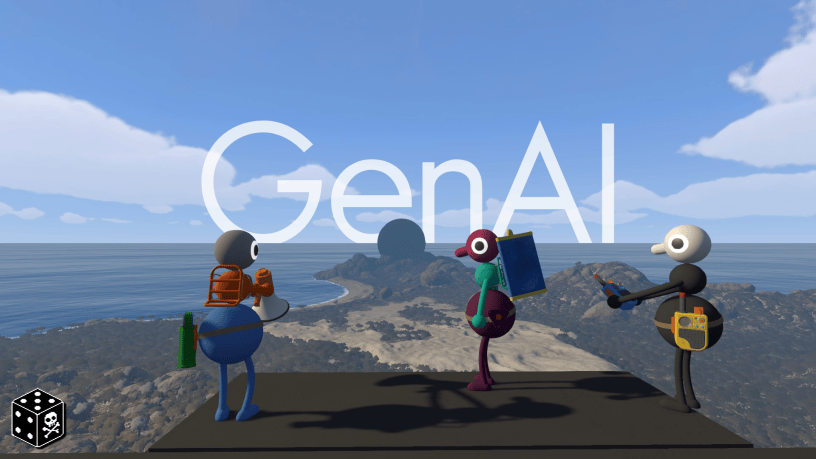
For about 25 hours over the course of a few weekends, myself and a group of 3 friends were captivated by a game we believed could contend for Game of the Year, and potentially Game of the Decade: House House’s Big Walk, a masterclass in world-building and showing-not-telling puzzlework. Big Walk has been a tour de force in the gaming world, storming out of the gates with over 1 million copies sold within its first week and a stout 91 on Metacritic, landing itself alongside other 2026 winners such as Mina the Hollower, Resident Evil: Requiem, and Death Stranding 2. It’s no surprise that Big Walk was to be in the running for several end-of-year awards as award season looms closer, but recently, a group of jurors from the Independent Game Festival have stated that no game that has used generative AI in any aspect, big or small, will receive votes from those jurors. To the surprise of many, one of the games that will feel the burn of this exclusion is Big Walk.
In a statement put together on House House’s website for Big Walk, the developer revealed its use of LLMs (Large Language Model) for “well under 0.1% of Big Walk’s code” as well as that some code generated by the LLM was “copied as a starting point to be modified into game code” in the final build of the game. This statement was put out recently and voluntarily in a disclosure to the IGF, then posted on their game website. However, this was not made available before, during, or months after its August 2026 release. In a gaming landscape where what is and is not considered “okay” with AI is being hotly debated (PixelDie currently declines to cover any games utilizing AI Art to any extent), House House’s inclusion of AI, however allegedly small, feels like the first real “hear me out” in relation to the ever-changing environment of LLMs, generative AI, and what they may mean for the future of code in gaming.
It’s no secret what the prospect of generative AI has done in recent years to communities and industries across all mediums. Artists have had to deal with tech bros unceremoniously stealing artwork from the likes of Pixar, Ghibli, and countless independent creators to create soulless pieces with the clickity-clack of a few typed prompts and use of a disproportionate amount of resources. This continuous march forward in advancements to become the biggest and best genAI model has caused the loss of jobs on a cataclysmic level, the introduction of new man-made disasters to our natural wildernesses, rural neighborhoods dealing with the insertion of data centers, and an ever-bleaker future for the AAA gaming world, where many talented individuals who have dedicated their lives to their passion of video games and other neighboring mediums find their careers dashed by tech stack decisions made by upper management.
Despite all this, the industry standards for “okay” usages of genAI are just as much in their infancy as the genAI models themselves. It’s hard to tell where we will be on this topic by the end of next year, let alone by the end of the decade, but the damage shown presently and its abhorrent uses will brand a scarlet letter upon any use case’s chest until the correct ramifications can be put in place to reduce and hopefully eliminate the damage to human livelihood. Just look at Steam’s most recent Next Fest and note how many AI-produced games are flooding the market, pushing hard earned creativity into the same trough as vibe-coded and stolen asset titles. It’s made the struggle for discoverability even harder. In response, the question is often asked: when you highlight all the unethical ways genAI is being used, the other side of the coin is that there must be a way to ethically implement genAI, right?
The hard answer is, not really. The disruption to workflows, long-term production support, and resource utilization typically far outweighs the increases in speed. Despite this, companies have been trying to find a happy medium where genAI can be minimally harmful and maximally useful, whether that’s rearranging various greenery and shrubbery within pre-made assets already developed by the company in games such as Everybody’s Golf Hot Shots, or in House House’s case outlined later in this article, utilized in a way that enhances the talent creating the game. Generative AI utilizing assets already created by human artists on staff, AI helping compile code from an in-house codebase, or AI providing potential answers to questions based on these human-made works, can, at least on some level, make a case for what genAI can do to aid production without endangering the livelihoods of the creative minds bringing their world to life.
Unfortunately, the newest battle for what is “okay” and “not okay” is taking place in a game many have already played.
In House House’s statement, they go into detail on the use of genAI and LLMs within Big Walk. To summarize their case: their internal team could not remedy an issue in Unity. A Unity rep wasn’t able to assist, and after exhausting all known options, they sent a request through a LLM that provided a potential solution. This ultimately resulted in a fix for what could have been a blemish on House House’s final product. House House goes on to state “This is not an endorsement of, or argument for, the use of AI tools, however minimal.” Considering studios have been shuttering regardless of their level of sales success or if they’re just in the crosshairs of a company looking to shed debt after a buyout, it is understandable, if not necessarily correct, that House House would opt for this solution when confronted with an issue that otherwise confounded the very people who built their engine of choice in the first place.
What does warrant blame is that they didn’t disclose this ahead of time. A version of the statement was submitted to the IGF in regards to being included in March’s GDC Festival of Gaming 2027 but was not included on their website, Steam, or any public-facing storefront. This only became a topic of concern with the IGF planning to omit their game, as questions were bound to arise given the absence of one of the most highly regarded indie titles of the year. It is now clear that House House knew their use of LLMs would put them in hot water within the gaming community, assumed such a small instance could be swept under the rug, and that the launch of a game with a 7-year development cycle could go unstained by the stigma that comes with AI use.
In a way, they were right. Big Walk sold over 2 million copies by the end of September and became universally loved by critics and players alike, ourselves included. The damage may be done to their trophy cabinet, but certainly not to their bottom line. From a financial perspective it would appear their gambit worked. Where this raises questions is in the long-term effects on their reputation among their intended audience, as well as their publisher, Panic, whose level of involvement and knowledge is currently unknown. If genAI remains a hot topic by the time House House comes around with their next project, gamers will be justifiably hesitant to throw their money at a company now known to be willing to withhold the truth until after their pockets are filled.

