
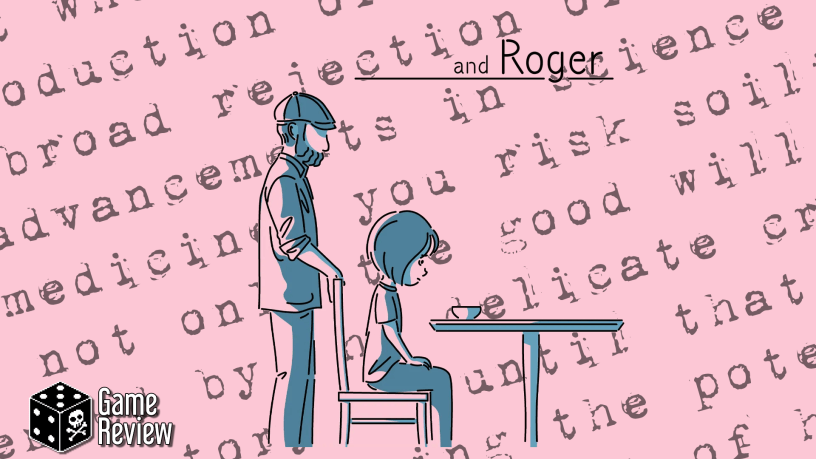
Video games that tackle heavier topics like mental health, disabilities, illness, and their complications have been a niche but necessary inclusion into the gaming world. It provides someone not suffering the depicted afflictions an opportunity to understand and empathize by way of interaction, to help better understand feelings and experiences that words alone may not convey. We’ve had several games over the years that placed players in the roles of others that are not the ideal but the important: Numinous Games’ That Dragon, Cancer, uvula’s To a T, and pretty much anything from Taylor McCue.
and Roger was a game that had been on my radar for a while, as I’m someone who has personally dealt with medical complications that at their worst have left me in need of assistance, similar though not identical to the state of our main character Sofia. I was intrigued by the premise of portraying short term memory loss and symptoms of dementia in video game form, especially when contrasted with my own past and current medical experiences, so I took the time to dive into the 90 minute point and click story to see what it was all about.
Chapter 1: A Story to Remember
(this article contains spoilers for and Roger)

Sofia’s story starts with her as a young child first dealing with memory loss and struggling to identify what is safe or dangerous in a house filled with ever-changing scenarios. A mysterious man telling you to eat your food, to brush your teeth, to take your pills, to go to bed. Where’s your family? Who is this person? Why must I take what he gives me? Taking some stylistic and pacing pointers from 2018’s Florence, and Roger takes a “more than a visual novel” approach to its storytelling by implementing small point-and-click puzzles and microgames to emphasize parts of the story to its audience. You’ll complete tasks by selecting unidentified options and memorizing their effects, correctly patterning the right choices in order; the concept of applying toothpaste onto a toothbrush and getting ready to brush your teeth becomes a 4-step program if you do it correctly, or you’ll cram an empty toothbrush in your mouth or dual-wield toothbrushes like you’re equipping sellswords in Dark Souls 3.
Certain senses help Sofia ground herself, better understanding when and where she is, notably the familiar smells of the local bakery where Sofia’s dad frequently accompanies her. That bakery remains relevant to Sofia in her adult life, where she eventually meets Roger, her partner and soon-to-be husband. We see Roger’s willingness to help; to be the period to Sofia’s sentences, working to lift her through her common issues and be a support system she can not only lean on, but thrive with. As we fast forward, we start to see the strain it takes on Roger to be a continuous help to Sofia. He starts to be out late, leaving Sofia with her Dad, often lost in prayer, to fill in. To help make soup, thank Him for the meal, and indulge in the company only family can provide.
As we move into their later years, we see the ups and down of a deflated Roger continuing to handle the forgotten moments of Sofia’s everyday life, like her defensiveness towards Roger about a spill she didn’t remember making, or drying stained clothing when she meant to put them in the washer. Roger looks…lost, trapped within his own morals, refusing to speak his mind. Sofia wants to understand but Roger finds the point moot as her memory will inevitably fail her after the conversation. After some back and forth pleading, Roger finally lays his cards on the table. Roger’s tired. Roger’s been violent to Sofia, which she doesn’t remember. Roger’s thrown himself to the Lord for guidance more times than he can attest to. Sofia finds comfort within Roger’s willingness to open himself to her and Him, and embraces Roger in forgiveness.
As Sofia looks to follow Roger up some stairs to help with a task, she suffers a fall that sends her to the hospital. Sofia starts to become enveloped in an unknown world of doctors and staff, much like the mysterious man in her childhood, pressing her on what she should do: eat our food, listen to our words, take our pills. Through the sea of mystery, Roger takes his time with Sofia, lovingly working through past memories to help Sofia regain her confidence in her sterile imprisonment. It eventually comes to light that He and Roger know better than the doctors and their established regimen of medicine and treatments, and that the word of the Lord, specifically identified in Corinthians 13:13, will guide them to wellness through faith, hope, and love.
…
Wait, what? Hold on-
Chapter 2: Pray it With Your Chest

When you think of Christian media, video games probably aren’t the first thing you think of. If you’re an old fart like I am, you remember the mid-day broadcasts of The 700 Club and shows like VeggieTales, where your sentient tomato and cucumber friend proudly state after every episode that “God made you special and He loves you very much.” There’s a prominent corner of media devoted to the teachings of Christianity, and like any other religion, its followers should be able to approach its values in a style that can captivate audiences more than the standard option of chillin’ on a pew for several hours on a Sunday morning.
But in the same breath of positively idolizing practices and teachings within a shared space of multimedia, there’s an inherent danger that can be done to the story in which you are telling. and Roger takes on an already touchy topic of handling a debilitating disease and sets your feet in the shoes of Sofia, ready to walk that mile. As someone who has Type 1 Diabetes, a side-effect of having a dangerously low blood sugar is suffering from dementia-like symptoms, with diabetes recently being identified as being a precursor to Alzheimer’s. The way and Roger places the player in a state of panic and concern by presenting several options and letting the player struggle to find the right one is very true to life, accurate to how it feels trying to handle basic tasks when you’re in need of getting your blood sugar back to normal levels.
The idea of Roger being the guiding hand to Sofia is something that I can keenly empathize with as my wife has helped me on numerous occasions during my times of need when I’ve had trouble handling diabetic-related problems on my own. It showcases a beautiful connection in learning someone’s missing pieces. But when that mold is an introduction of religion and the broad rejection of the vast advancements in science and medicine, you risk soiling not only the good will presented by the delicate crafting of your story up until that point, but also risking the potential good will you present of how your religion helps you and the others around you.
Chapter 3: Two Gods Don’t Make a Right

I’ll be the first to admit that the world of medicine has its downsides. Insulin is a medicine that I have to take to survive, unless I just want to eat lettuce for the rest of my life, and insulin in the United States is not cheap in the slightest. I did a study in 2021 of how much 4 months of insulin would’ve cost me out-of-pocket if I were to buy it without health insurance and the combination of 3 medications: 2 I cannot live without and 1 that makes handling my diabetes much easier, would’ve cost me $6,500. This was 5 years ago. I can guarantee you that the number has gone up.
But while the medical system will try its best to kill me, I would’ve been long gone without the benefit of scientific advancement and the doctors that have helped me since my diagnosis 13 years ago. So it…really pains me to see and Roger take every chance it can to demonize the use of medicine and the people who work tirelessly to care for their patients in need, insisting that faith and God will work better than proven science. It leaves a stench upon this game that did not have to be here.
In an interview with and Roger’s developer, Yona, he recalls his father’s battle with ALS and wanting to take up a career in medical device manufacturing before the mental strain of pharma companies prioritizing profits pushed him to return to his faith and find a way to become closer to God. Listen, I completely get it and I don’t blame him for removing himself from that career path as his issues with pharma companies in Japan parallel the issues of pharma companies in America. But the ten-toes-down approach of villainizing everything and everyone in the medical world for and Roger not only undercuts the overall message of handling a debilitating disease that Yona does an amazing job portraying, but it alienates whole audiences with a vitriolic stigma based on past experiences all in the service of its creator’s current theological foundations.
There can be a world where faith and science live cohesively together, but and Roger, surprisingly, forgets-

