

By the cards held o’er the felt, something wicked this way’s dealt.
You probably already know that cards and numbers have been having a moment. Trick takers and shedders are so very, very hot right now and I’m sure a lot of people’s immediate points of comparison for 3 Witches would be the last few years’ deluge of increasingly niche releases. Hell, Allplay would probably prefer I use that lens! No, instead I took a swig of this elixir and found myself transported back to 2012, at the very height of the microgame boom.
Remember Love Letter? Coup? Kobayakawa? That early 2010s window where designers collectively fixated on doing a lot with a little? An era of velvet drawstring bags, social mechanics, and a curious fascination with having fewer than 20 cards. Sure, many of them didn’t stand the test of time (though games like Cypher deserved to), but I look back on that time of novelty and experimentation fondly.
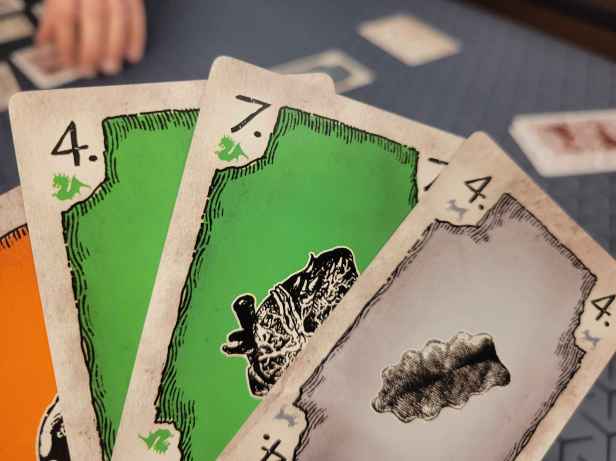
Anyway – I bring this up because 3 Witches ticks all the boxes. Tiny box? 18 cards? Deductive elements? Phenomenal presentation thanks to another round of beautiful Sai Beppu art? Admittedly that last one has nothing to do with it and I just wanted to give Beppu her flowers, but you get my point: this is a microgame! It waddles and quacks like a duck! More importantly, if microgames back in the day were this good, the trend wouldn’t have died nearly as quickly.
3 Witches is a trick taker played 2v1, similar to Dou Dizhu or Chimera. Whoever feels their 6 card hand is strongest wins the bid, with the winner then becoming the lead witch and a problem the other two players have to solve. However, and get used to me throwing curveballs because this game barely knows how to throw straight, this bid is restrictive to the point of feeling like a straitjacket. This game has a whole 2 possible bids: winning exactly 3 tricks, and, wait for it, winning exactly 4 tricks. A hand of 3 Witches consists of playing 5 whole tricks. This means that a player who is truly dealt a ridiculously powerful hand may legitimately consider passing, as a lead witch who wins everything can never hit their bid and grab those sweet, sweet two entire points. You need strength, but tempered with finesse. Fair is foul and foul is fair.
Things get weirder, because of course they do. This game’s tricks aren’t just a single card: the lead witch plays a faceup card (which must be followed) and a facedown paired with it. The lesser witches then each play a card to the trick face up. There are multiple exceptions and wrinkles to that last sentence – rules for passing, lesser witches having to play face down if a 2 is led – but if I turn this into an entire rule rewrite we’ll never get to the point. That point being, each team is playing 2 cards. If anything matches, as in both cards have the same rank or suit, their values are combined. This reveal is even more climactic if the singleton elixir is played, doubling the value of the card it’s paired with. Turns out it’s a lot easier to win a trick when you can double, double, toil and trouble for a value bigger than the deck even contains!
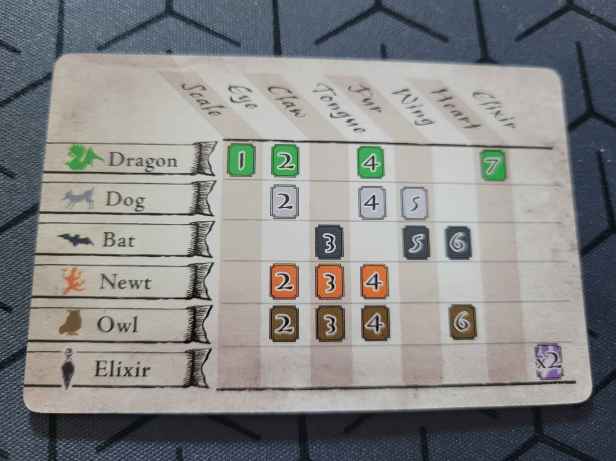
Said deck will throw you for a loop for at least a play or two. This game comes with 3 player aids, which you will need because this deck’s composition is hyper specific. I have to imagine it took Corey Young ages to nail down in testing, because I could not begin to guess how he landed on this exact suiting and ranking. Five suits plus a one-off elixir across an 18 card deck, and not a single suit has identical ranks. It does make card counting in your head a bit harder, but it also means that after a few plays it’s notably easier to track whether or not a specific suit is fully depleted, which you’ll need if you want to really put up a fight. Deduction-adjacent! Never beating the microgame allegations!
Let me take a beat to note a few more components of this brew that warrant a mention. The lesser witches have to discard down to 5 after they lose the bid, but before playing, and those cards aren’t disclosed to the table so you’ve got some unknowns to wrestle with. The lead witch gets a card returned to hand after every trick, but who selects the card is determined by the trick winner and there’s an element of hidden info if they win. Communication between the lesser witches is limited, but a well timed pass can speak volumes. Wheels within wheels, mechanics within mechanics, a bubbling cardboard cauldron that explodes far more often than not, which makes wins for the lead witch feel like an event. One of my favorite experiences in any game with shifting teams is that moment when a teammate turns on their partner and sandbags a key trick intentionally, knowing full well that they’ll go down too, because letting their teammate get any more points is worse for them than giving a W to the solo player. 3 Witches achieves every emotional beat that makes these games compelling, distilled down to its very essence.
None of that is to say that the distillation process comes without consequence. Similar games that predate this one often allow for a bit more player expression and strategic variability – wider bid ranges, melds, more unique cards like the elixir, larger hands with wider decision space, etc. As a result the appeal of this game is deceptively narrow; this one’s more for the card game sickos than the folks that’d pick it up on presentation alone, almost to the point where it feels like an odd fit for this particular Allplay line. A lot of this game’s appeal lies in the tightness of its scope and its funky interactions – nothing here is unintentional – but understand that you aren’t in for a new lifestyle game here.
No, you’re getting a top shelf microgame that’s been perfectly preserved, sealed in amber, frozen in time. 3 Witches is as slight as it is impressive, a testament to Young’s development chops. This design is honed to a point as fine as a butterfly needle’s, complete with a tendency to sting about as much when you inevitably find yourself a victim of your own hubris and duff your bid. Clever, novel, unique; a contemporary trick taker far more innovative and compelling than yet another “Hearts With a Twist” riff or what have you. Thou shalt score points, though thou have none.
8/10
Review copy provided by game designer.

