
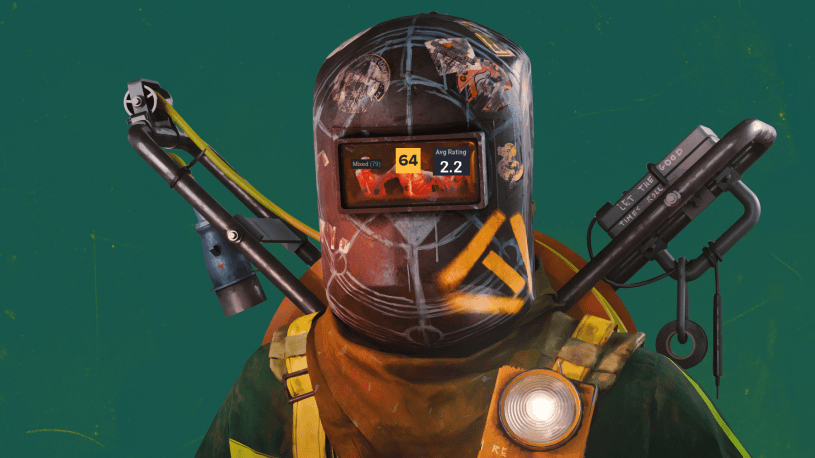
Life has many builds, fed boy.
Let’s take a moment to thank the Finns for making a game about firing guns in a federal office available for a free weekend during a particularly shitty time to be an American. I haven’t one-tapped so many federales with a pump action shotgun since Payday 1! That’s my most patriotic pastime! Hit it, DJ!
I considered opening this writeup with “Firebreak is good, y’all are just mean”, but I wasn’t in the trenches on release. Hardly anyone was! It could have been abysmal for all I know! Regardless, the current state of the game has plenty of enjoyable stuff to do, or at least as much as you could reasonably expect in a now-$15 Left 4 Deadlike. In the same way that Crime Boss: Rockay City arrived on Steam with bargain basement prices and felt better than comparable disastrous releases as a result, Firebreak manages to be an above average take on the genre by way of having some neat ideas and not exploding on impact with people’s computers. Sure it’s got rough edges, and some of those are going to hurt its long-term appeal even among the sicko set, but the positives outweigh ’em. What, don’t believe me? I’ve beaten all the missions! I’ve maxed out all my kits! I’m the closest thing to a subject matter expert you’re gonna find on the likes of backloggd dot com!
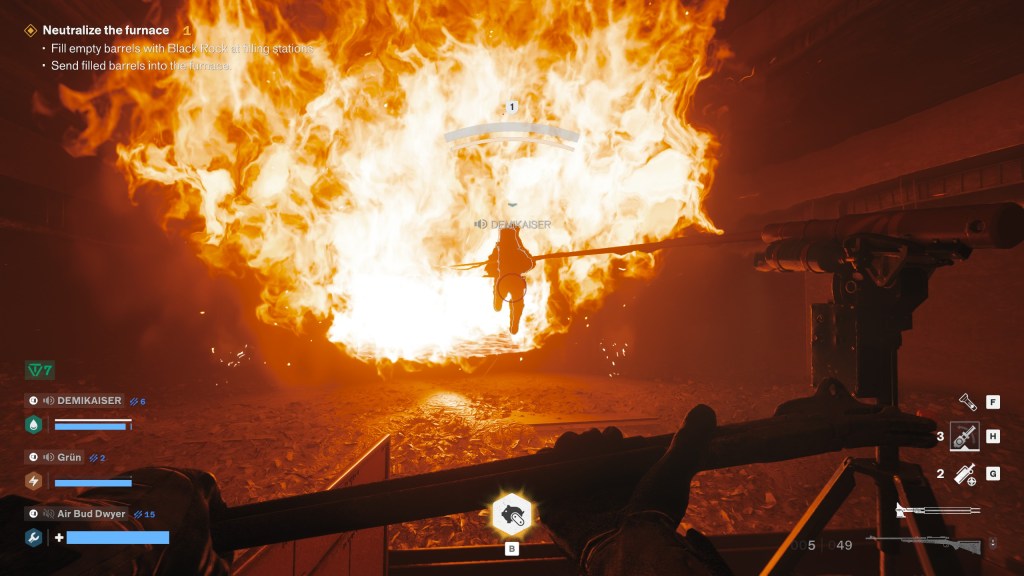
Let’s talk structure for like, 2 paragraphs. Firebreak typically sees you taking on 3 act missions that take 20ish minutes. Think of it as a truncated version of L4D’s safe room airlocked sections, but instead each section is connected and walkable. Each map chunk gives you an objective from a short list of possibilities. For example, an area with a payload cart could either task you with collecting irradiated rocks and chucking them in, or ignoring the rocks entirely in favor of blasting all the rock-producers. Once your objective is done you can open the door to the next one. Repeat until you’re at 3/3, then it’s time to bail all the way back to the start of the map and extract via elevator. All of this menial labor is made more challenging by endless hordes of Hiss, as seen in the hit game Control! Branding! Synergy! Remember Control? Remedy sure hopes you do! Unfortunately for them my experience with that game was getting about halfway in before hitting a game-breaking bug on the console version soon after release, and that game’s combat was by far my least favorite part, so you’ll have to forgive me if I don’t know who any of these goobers are. Also they added a wave mode in the most recent patch, but it’s shallow and not particularly worth talking about.
Anyway! The rest of this game’s bones lie in character building. Almost every co-op shooter is laden with a perk system now and Firebreak lands on the more complex side of the fence. Not quite a Darktide but notably more involved than a Helldivers 2, for reference. You can build all kinds of wacky shit but what I find most interesting is how the progression is split. Your character level governs your perk access, but the 3 work kits level separately (to a low ceiling of 9), and that dictates how many perk slots you can bring on a job. Loadouts are a single customizable gun, which isn’t kit restricted, and a support tool that very much is. In summary: you do missions to gain levels to upgrade your goober so you can do harder missions. You’ve played this sort of thing before, and it’s done pretty well here, especially considering they apparently upped the XP gains from what was once gruelingly slow.
Structure’s great and all but it’s only worth as much as the gameplay it’s supporting, and Firebreak’s is solid. Movement is weighty yet responsive, with animations that typically don’t allow for cancels meaning you need to commit to the hit. The 9 guns are a mixed bag presentation-wise – the machine gun sounds so anemic that I swear they took all of the effects intended for it and fed them to the others – but they’re all usable in the field and do an excellent job of flinging ragdolls around with comical force. The scattergun and semi-auto rifle are standouts, which is funny considering they were both added post-launch. I’m starting to notice a pattern with some of my favorite bits of this game! Regardless, the result is a combat experience better than the average co-op shooter in large part thanks to a heavy emphasis on positioning. This is enhanced even further on missions where Control‘s wacky items start floating around, invariably causing your squad grief until you find a tool to blow them up or bring custom gear for that exact purpose. Creating chokepoints, covering each other, knowing when to rotate to a new area, and juggling all of that with accomplishing your actual objectives makes success in a Firebreak mission significantly more satisfying than your Killing Floor 3s of the world.
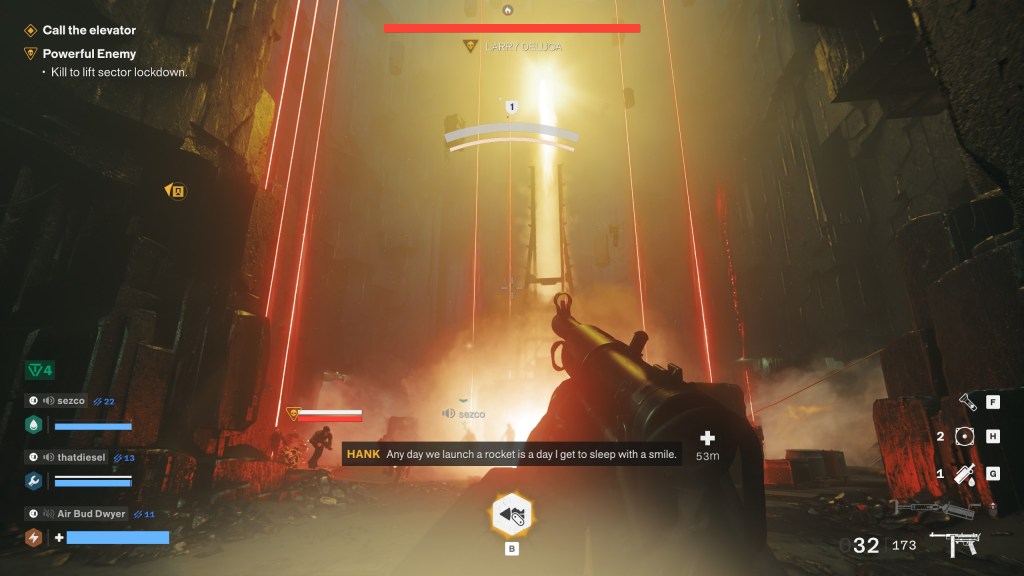
That said, the kits have impressed me more than the gunplay. This sort of build-your-own-class thing is rarely done especially well, and I’m not 100% convinced Firebreak fully sticks the landing, but it does manage to be a lot more interesting than most by separating your non-combat tricks from the rest rather than pulling a Helldivers and over-consolidating. Your objectives often demand QtEs of you and they aren’t particularly quick, but applying the correct secondary tool to the right task will just one-tap it, skipping that whole process! Very important, especially in higher difficulties when the pressure’s on. What makes this more interesting is the tension created by each kit’s combat utility, how they mesh into a build, etc. You could always bring all 3 kits and that’s fine, but favoring a specific secondary’s combat benefits is a legitimate reason to not bring anyone specialized in a specific objective! That’s neat!
I should probably talk about what they actually do. The Fix Kit offers enhanced horizontal movement, a decent melee swing that you can center entire builds around, and the most frequently used task-aid as you will need to repair doodads and pipes a lot. Every kit comes with an emplacement and this one’s a cannon mounted on a swivel chair, which is high-impact but has a tendency to roll from recoil and create friendly-fire situations if your team isn’t alert. Its parautility (it’s an ult, I’m calling it an ult) sees you slapping a Piggy Bank onto the end and sending it out as a boomerang tornado. Simple, effective, best kit to give a new player, arguably the kit your team should never leave home without. The Jump Kit lets you zap enemies to death and machines to life, which is neat and all, but the actual highlight is its piston that you can charge to essentially rocket jump with no damage. Fall damage is barely a factor, so any Jump user worth their pretzels will be constantly pogoing around, often making use of weapons that reward them for creating distance or closing it depending on their playstyle. That ability to create distance is further rewarded through use of the Gnome ult, which essentially fills an entire room with a lethal storm AoE that you really need to warn your teammates about. I find myself leaning on its boomboxes pretty heavily as a taunt followed by an explosion is kind of an amazing thing to get a regular supply of. Sure it’s not as immediately handy as a L4D pipe bomb, but few things are.
The Splash Kit gets its own paragraph because it’s arguably more complex than the other two combined. There’s no movement trick here, and few direct damage applications either! Instead you get a pressurized hose that can either work like you’d imagine or launch big charged up globs. Water is kind of a huge deal in Firebreak. Group showers are your heal stations, and any source of water (ceiling sprinklers you shoot, the Splash Kit’s hose, placeable dehumidifiers that you can fill) can clear status effects, of which there are tons that I do not intend to dwell on but you can imagine how combining wet with electricity would be productive. Water puts out the surprisingly common fires all over the office and enemies being on fire is just straight up bad for you, so giving the Hiss a drink from the firehouse periodically helps a lot. The dehumidifiers also act as heal stations most of the time, and I say “most” because everything changes when you pop your ult and mount a hot kettle to your hose, swapping everything from water to fire. Spray the hose? Flamethrower. Fire a glob? Giant fire explosion that’s likely to cause friendly fire. Load the dehumidifier? Now it’s a flame turret that can hold a hallway down for you. I don’t know that I’ve done the best job of expressing this in the text so let me state it outright: this is one of my favorite support ability sets in a co-op shooter, full stop. Gone is the dirt simple traditional medigun setup, replaced with heaps of utility that can be applied all sorts of ways on offense and defense! Choosing when to flip modes is an excellent puzzle that I still haven’t mastered, especially since it’s so easy to torch yourself if you get overrun while in spicy mode, and I appreciate that complexity.
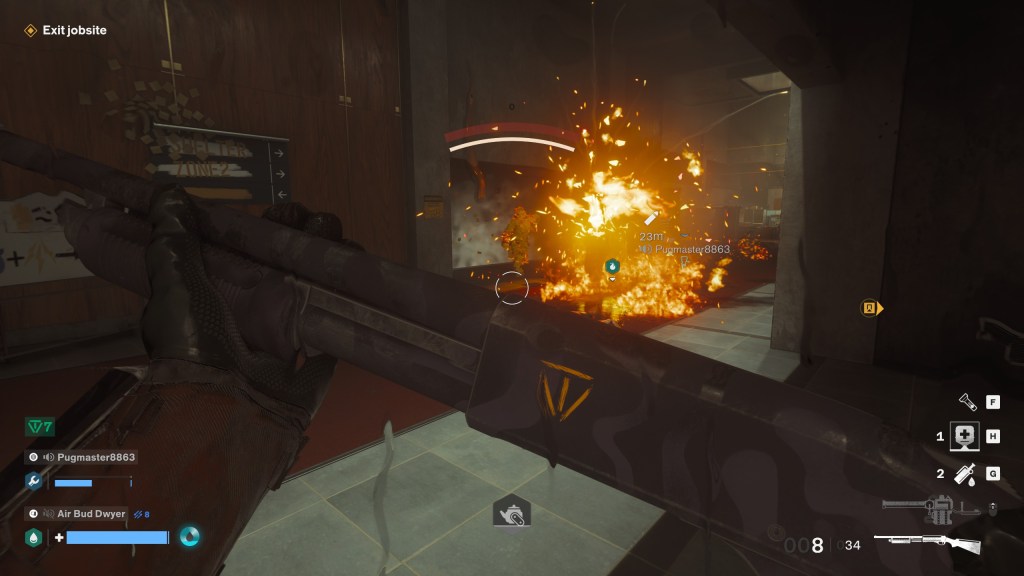
So far I’ve been very positive, and deservedly so because I do think there’s a lot to like here, but it’s time for me to start complaining. This game’s 4th and highest difficulty, Extreme, is a tragedy. Hard (3/4) lives up to its name but is entirely surmountable without requiring much for perks if your positioning is good and your communication is on point. Expert, though? Nightmarish. I cannot conceive of a build that addresses every Hiss in the tri-state area showing up with 3 times the health and guns they can actually aim. Combine this with the “hey forget the mission, just kill Hiss actually” surprise objective that’s already wildly overlong and has no way to speed up its glacial progress bar, and you’ve got a recipe for misery. It’s not that we can’t beat Extreme missions – we’ve won more than we’ve lost! – but the play patterns they demand just aren’t fun. I don’t want our squad to have to stack healing grenades, armor-piercing weapons, and 3 points in defensive perks just to have a chance, I just want to perform non-combat tasks under fire and express myself via build variety! Hitting that balance and spinning plates is why I’m here!
So we play on Hard, because it’s actually fun and anything lower is a cakewalk. Not the biggest deal, plenty of games only have one difficulty that hits the Goldilocks zone. This game’s actual most significant weakness by a country mile is the enemy pool. It lacks L4D-style special infected, instead going for the typical horde shooter sea of bland (mobs, heavies, fliers, ranged, that’s about it), and you feel their absence. Fights have predictable strategic and emotional arcs instead of the sudden memorable story moments that these games can do so well, and the tactics you employ are repetitive as a result.
I wish I could say the elite Hiss that spawn with normal American adult names spice things up, but they’re just enhanced versions of preexisting enemies picked seemingly at random, which means at any given moment you can have a red alert boss lifebar appear for a basic mob who immediately gets dunked on. Don’t get me wrong, we get a lot of comedy out of being able to drop sentences like “wait we can’t leave yet, we have to murder…Jeffrey Fernandez?”, but these guys could have been great instead of further exacerbating the game’s Achilles’ heel. Even more perplexing are some of the enemies that show up on high difficulties, like the Orb, which as far as I can tell are entirely unexplained in-game. It seems to buff the Hiss? Maybe? We treat it as a priority target and shoot on sight because it’s a large glowy thing that looks imposing, but I could not tell you with any confidence what it actually does.
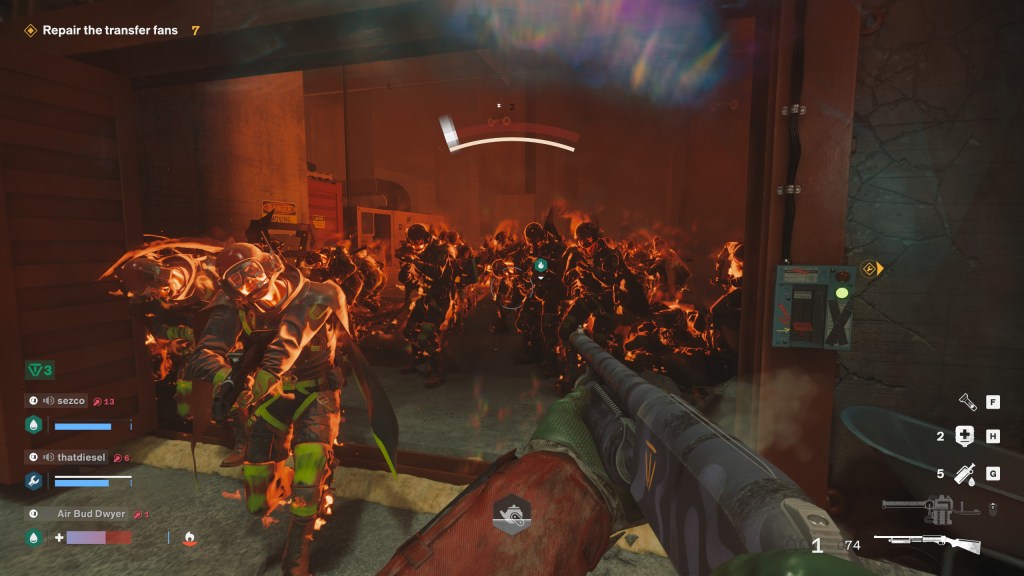
The thing is, and if there’s one point you take from this writeup let it be this one, I kind of don’t care? Firebreak is fun! I have no investment in Control as a property and I’m not being some kind of contrarian intentionally – this game passed muster for me and 4 different friends over the free weekend to the point where we felt compelled to pick it up entirely unprompted just so we’d be able to keep playing. We had rotating seats! We were breaking for meals and cutting them short just to play more! I’ve already hunted down all but 5 of the achievements! We’re probably gonna play it more later this week once we wrap some obligations for this very website! There’s a wholly subjective it-factor with multiplayer games like this, and for all its flaws, Firebreak’s vibes are pristine for our group. Just like we are after our 5th trio shower of the mission. Caaaaaaan it beeeeeee, weeeee’re so cleeeeeean!
Look, I get it. No Remedy fan wanted this game. No lifestyle gamer wanted it either, innately repulsed by a product with more game to play than base Left 4 Dead did on launch as opposed to a contemporary content treadmill. Every non-game design decision made leading up to the release of Firebreak looked, both at the time and in hindsight, like it was carefully tuned to shoot off as much of its own foot as possible. Yet somehow, in a very FBC-appropriate weird turn of events, they managed to release a game that’s just for me and my friends. Not yours, specifically me and mine, only it took us 8 months to find that out. I’m not here to tell you that Firebreak secretly the greatest FPS that you aren’t playing or anything, but when this game’s servers inevitably go down and Remedy doesn’t bother to reconfigure for peer-to-peer because the player counts are in the double digits, I’m going to shed a tear for all the missed showers we could’ve had together. Sorry about the profit warning, Remedy! I don’t think a few deeply discounted purchases after this free weekend is going to cover your losses, but hopefully they keep the break room stocked with Juhla Mokka for a week while y’all work on Resonant.
 Reviews as Fair as a Die Roll