
Looking at the pedigree of AdHoc Studio, the studio’s success was a reasonable expectation. Their first title, Dispatch, released last year to critical acclaim from reviewers and players alike. Weaving the narratives of several characters with the same grace of Telltale past, a spin on the superhero genre, and casting a wide net of voices you’ve probably heard on YouTube or HBO Max, Dispatch stands tall with a score in the high 80s on Metacritic. I love me a visual novel, I’ve loved me several a Telltale game in the past, so everything about this game should have me doing the same song and dance in praise of this new IP. Instead I’m finding it hard to fully commit to telling people you should play this game. I guess I still don’t really know how I feel about it.
If you were like me and waited several months to finally get around to playing this game, here’s a quick rundown: you play as Robert Robertson III, a superhero lacking in powers but making up for it with a high-tech Mecha Suit capable of picking up the slack. When a mission gone bad takes his suit out of commission, he’s given another opportunity to bankroll fixing it in exchange for working as a dispatcher for a rag-tag bunch of supervillains trying to change their ways. Robert is tasked to guide the “Z-Team” through helping with smaller tasks around a segmented piece of Greater Los Angeles as the Superhero Dispatch Network (SDN) works to get Robert back in his suit and to his ultimate goal: finding the supervillain, Shroud, and exacting revenge for murdering Robert’s father.
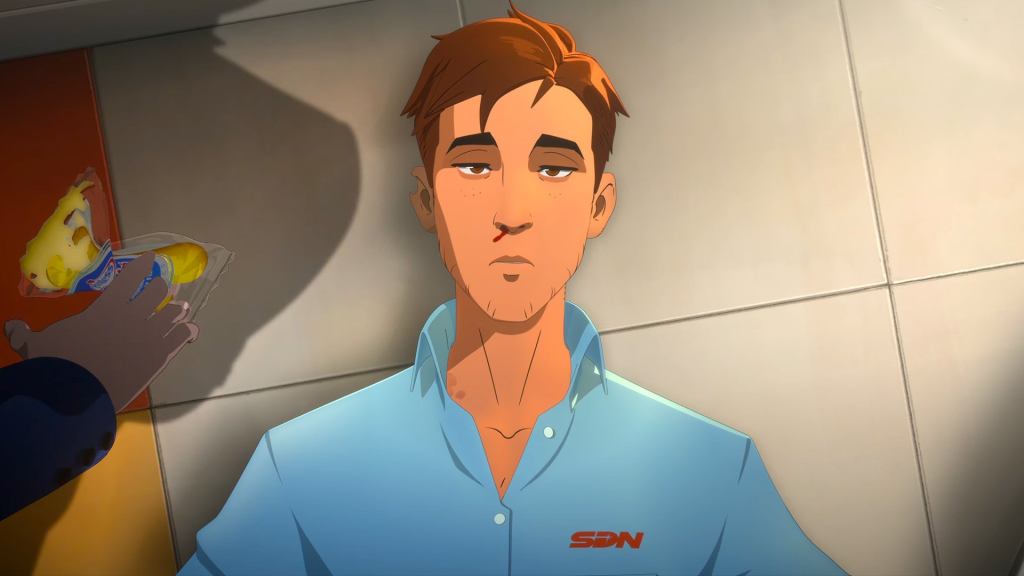
The Telltale vibe is met almost immediately from the get-go as the star-studded cast is introduced with Aaron Paul voicing our main character, Robert, aka Mecha-Man. The visual quality, directional vision, and scene pacing mirrors TV quality as you’d expect from a team with the kind of resumé its developers possess. Your usual 2 to 3 options are given at narrative choke-points within conversations, bobbing and weaving through flags where people will remember the choices you’ve gone with and how you handle your internal decision-making. Dispatch isn’t looking to reinvent the narrative wheel and recognizes what drew people to previous games, keeping its narrative adventure DNA intact to great success. The season is broken down into 8 episodes that were released in pairs weekly after launch and I had plans of playing through this game maybe 1-2 episodes at a time, but as Telltale games tend to do, they had me hooked after episode 1’s conclusion and I ended up playing the whole damn thing in one night.
Later on. Robert learns the dispatcher ways at his new cubicle within SDN’s headquarters. Here’s where the real meat and potatoes of Dispatch are served: a day’s work is handled in 2 shifts and each help-in-need marker will ping at various areas within your team’s county limits. These requests from the cityfolk will range from personal defense detail, to menial old-people helping, to infiltrating villain strongholds, to hacking SDN-protected establishments to assist with their current predicaments. These scenarios are handled by selecting a number of Z-Team members based on context clues of the task at hand, and utilizing the stats of each member to help cover the need of the request with a percentage-based skill check.
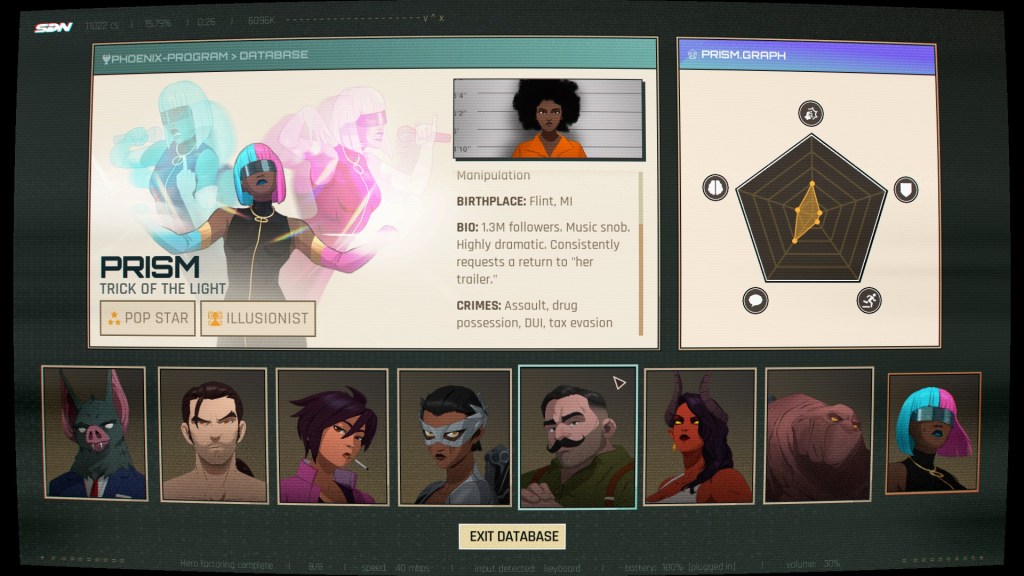
Each team member has five distinct stats, with team members specializing in one and upgrading freely as they level. Scenarios have a base set of stat expectations that are needed to satisfy the request; how your team members are chosen will essentially “overlap” the required stats with the combined stats of the individual or group of team members set to do the job. If the team’s stats cover 100% of the stats needed for the job it’s an instant success. Good job reading the room! If they don’t cover fully, the pass or fail is designed on a dexterity flick disguised as a dice roll mechanic, if the marker lands in an overlapped area, you win, if not, you lose that scenario. Winning grants EXP that can be used to level up while losing can injure (lowers stats of the team member until you heal them) or down (renders the team member unusable until healed) the team member. Handling scenarios takes time and team members will need rest between calls, so prioritizing who goes where and when is necessary if your team is going to handle all calls in a given shift.
On paper, this is a fascinating way to showcase your team members’ skills in a way that could be built upon in later chapters. Identifying the strong suits of each team member will allow them to thrive in each call and earn higher EXP gains so the teams are ready for whatever tasks are ahead of them in later chapters. This could also, in theory, increase or decrease your team’s morale throughout the campaign based on usage and success rate. Obviously your super-villain team trying to do good will want to showcase their efforts in a way that at the end of the day accumulates into something tangible that also shows how the player is handling calls as a Dispatcher, and making sure a high success rate is managed on a day-to-day basis? Right? That’s why we’re spending over half of the game’s playtime on these loops? Working towards something that will be judged later on in the game? Like what previous Telltale games did all the time? Building up to a final judgement check based on all our previous notions and working togethe-
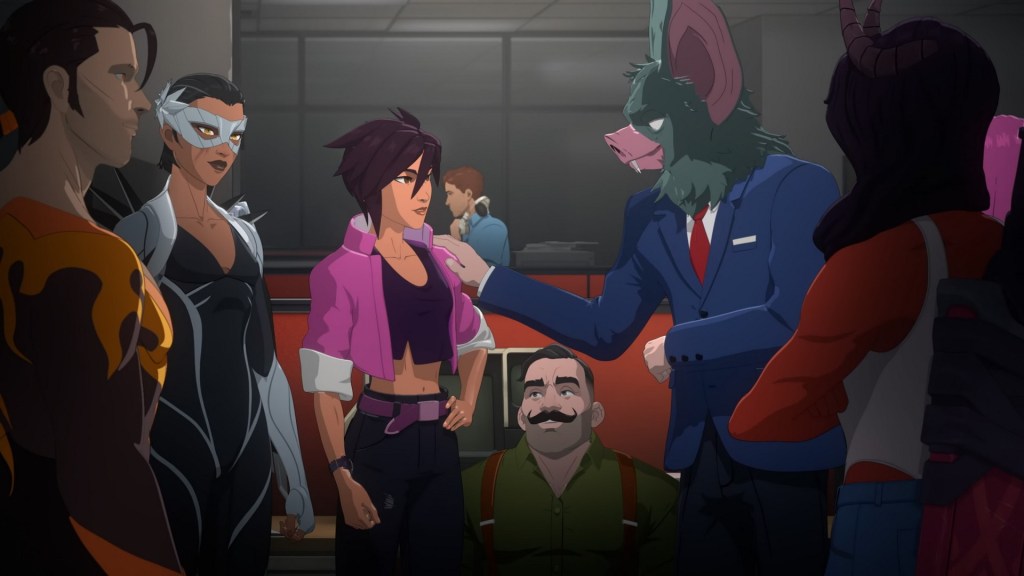
Fuck no, these gameplay loops have no bearing on the plot’s direction. It’s essentially there for you to play Pocket DM to a bunch of CPU-driven characters for the express purpose of lengthening this game from 3 hours of cutscenes to 9 hours of game time. You could get up out of your seat, get a cup of coffee, leave every single distress call on read, and Dispatch’s central plot would be none the wiser. Imagine taking your award-winning Telltale game formula, and after 20 minutes of engaging plot and memorable characters it slapped eye clamps on you, put a controller in your hand, made sure to inform you that the following broadcast was sponsored by Critical Role, Dimension 20, and its partners in all things D&D for the next half hour, and didn’t allow you back on the ride until you cleared your intelligence roll. It doesn’t shock me to see how much of this game is dipped in the hyped surroundings of tabletop RPG-style skill checks given that Critical Role is all over the studio’s current and future projects, but I don’t think AdHoc had the time or tools capable of sandwiching the two worlds of Telltale and D&D to create a palatable dish.
It’s such a baffling decision to have more than half your game be content-filler. The only explanation that feels even close to reasonable is scope creep, and what hurts more is when you add the context of the studio’s tumultuous history of funding issues due to the COVID pandemic, using The Game Awards as a last-ditch effort to secure funding to complete the game. In July 2025, Critical Role announced a partnership with AdHoc, namely to co-develop a game set in the Critical Role universe, but to also finance the final stages of development for Dispatch. I feel like in a few years when AdHoc’s new game with Critical Role comes out, it’ll be all the clearer that Dispatch had to crawl so the studio could run.

Dispatch was a rousing success, selling over a million copies in its first two weeks of release. It has effectively saved AdHoc from closure and I couldn’t be happier for the success of both the IP and the studio that had to roll through broken glass for the better part of a decade to get it out the door! But when I see universal praise across the board for a gameplay loop that has the same emotional investment as the ending to Mass Effect 3 that leaves it as the top contender for “Best YouTube Supercut of the Year,” I just kind of shrug my shoulders and wonder: is it just me, or are we cool with forced immersion in a world without consequence? Believe me, I’m acutely aware of the irony of a visual novel fan being a little upset with a game playing itself, but I feel Dispatch deserved more and better after all is said and done.
 Reviews as Fair as a Die Roll