
Hobblin’ Goblin
PopCap’s acquisition and subsequent EA-ification left a hole in the market that’s never been truly filled since. Their games were simple to pick up, as replayable as you could ask for, and addictive to the point where they were categorized as Schedule II by the DEA. I’m so perpetually PopCap-pilled that I actually just got my Peggle recertification earlier this year, so imagine my surprise when Peglin hit 1.0 not too long after. I thought I was more than prepared to put my skills to the test, but it turns out that’s not quite what this little green dingus had in mind.
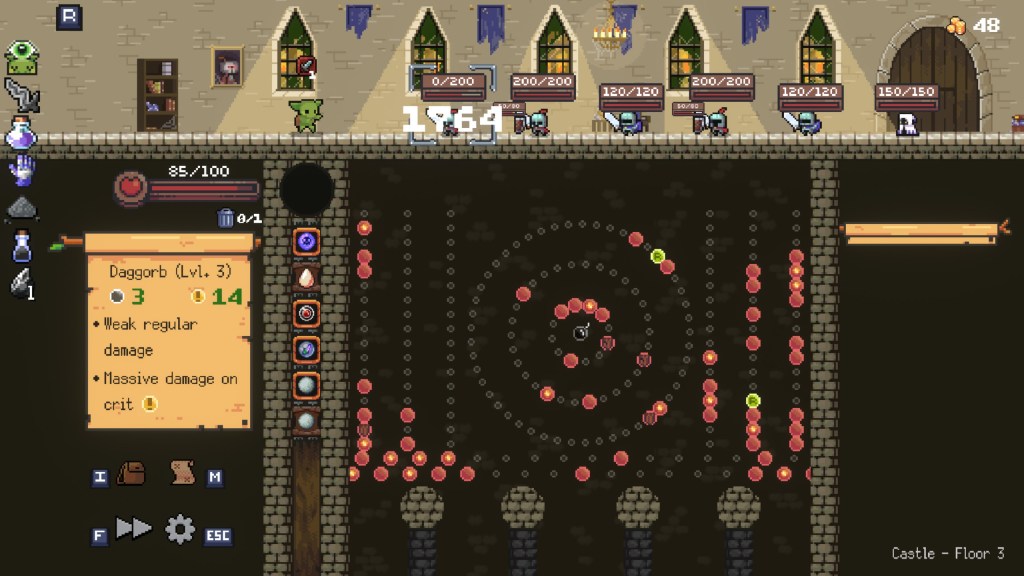
Peglin resembles Slay the Spire, only the combat has been Peggle-ified. Anyone who denies that is lying to themselves. But Red Nexus Games calls it a Pachinko roguelike on all official pages (presumably for legal reasons) and that comparison does clue you in a bit more as to what you’re in for: pointing your orb in the best possible direction and letting it rip. This isn’t a game of landing precise long shots and slam-dunking buckets, it’s about making gear decisions and watching them play out as your orb ricochets wildly and you pray for a jackpot.
The thing is, that isn’t an oversimplification for the purpose of a quick summary. Combat contains little to no decision making. The physics are squirrely at best and boards are target-rich, meaning any ability to predict outcomes is extremely limited. Of course you can aim, but on many boards your ball starts in enclosed spaces or at funky angles, making even that essentially a moot point. Instead the game backloads all of your decision making to the post-fight acquisition of orbs and relics. To again invoke Slay the Spire, these are your cards and, um, relics. It’s a tried and true framework, but in this case everything atop it is rickety.
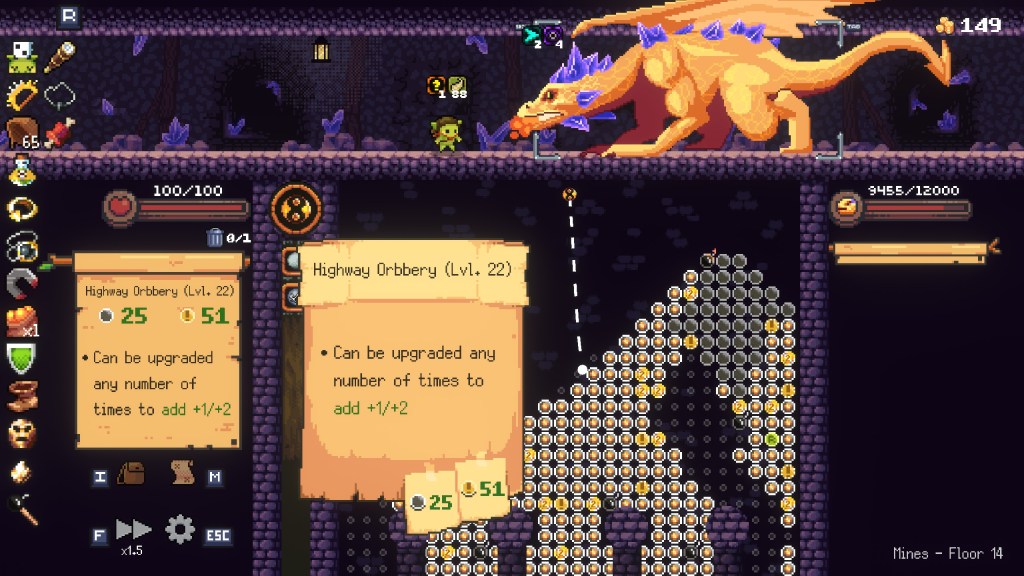
By far the most frustrating piece of Peglin is the design space of its relics. Several of the game’s best pieces, reliable run-winners, constrain your decision space even further. Giving up free aim for multiball, money for damage amp, or having the game just yank your ball directly towards special pegs, ends up narrowing your involvement to the point where all you have to do is click. Successful builds solely need to pass the game’s scaling DPS checks and these relics are the best ways to do that, making strong runs significantly more dull than weaker ones. I could understand if the intent was to create a pachinko-esque experience where you hit the lever and watch the spectacle, but there’s not nearly enough going on visually to achieve Vampire Survivors’ levels of chaos and if Luck be a Landlord can adapt a completely agency-free money burning device into a compelling game, why are we doing the opposite here?
There are a lot of smaller nicks in the ballwark here as well. Builds are largely at the mercy of RNGesus thanks to minimal opportunities to lean into particular keywords or mechanics, even with the character that grants an additional choice. The game has a fast forward option, but it only goes to 1.5 speed and still requires significant waiting to line up shots in several stages. Choosing your next location is beholden to the bounce of the ball. Events have multiple outcomes, so every interaction with one is a tossup, meaning you tend to avoid them. Combine all of this with how short a run is with no ability to keep playing after a win, and you’ve got an arc that feels more like it abruptly stops than properly ends.
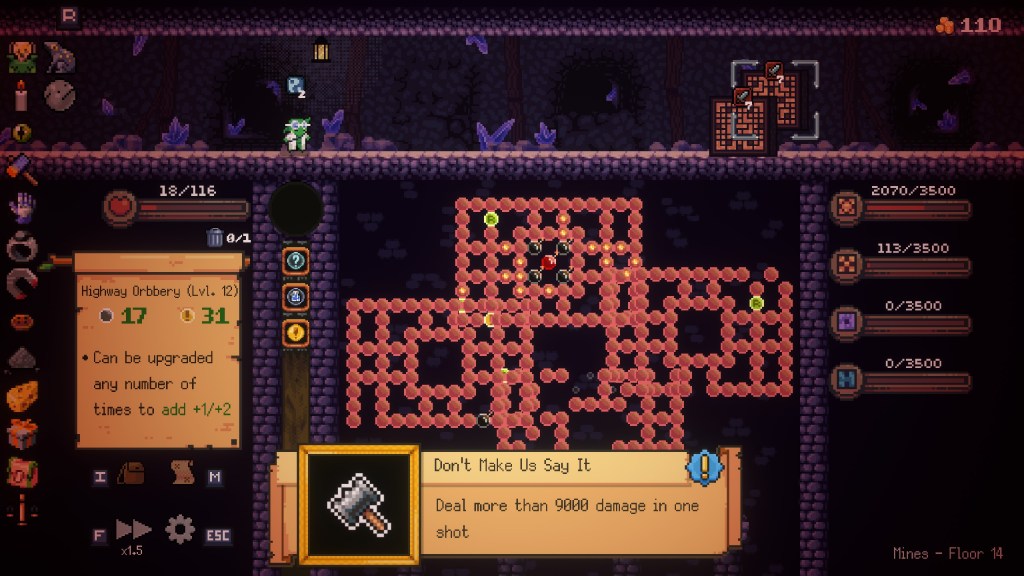
I lack an adequate segue for this so I’m just going to take a moment to complain about the game’s audio, or lack thereof. This game is bizarrely quiet, with pegs barely acknowledging impact and enemies having almost no sounds at all. With the exception of the forest zone’s peppy combat theme the music is barely present and entirely forgettable. The only satisfying sound in the entire game is the deep fried impact of throwing an entire board’s worth of bombs at the same time, and I’m not entirely sure that was intentional. Gambling games rely on flash and fanfare to keep players engaged but Red Nexus Games apparently did not get the memo. I hate to apply the label of “podcast game”, but Peglin practically demands that you add something for your ears to do.
Despite all my whining, I actually do enjoy Peglin’s gameplay loop! To some extent I do feel I’m grading on a bit too harsh of a scale here when I’ve beaten all the bosses, unlocked all the characters, and completed several Cruciball runs across said characters. The sad bit is that at this point that means I’ve seen everything worth seeing, done everything worth doing, and found myself disappointed with where that leaves me. Peglin is a decent game, and technically a complete one, yet I can’t help but feel like there’s a significant amount of underutilized potential for a game with such a strong core conceit.
 Reviews as Fair as a Die Roll