
Feels off.
We’re fortunate here at Pixel Die. We get to play games that interest us, be that for positive or negative reasons, and everything else just kind of falls into place from there. One of the only downsides of this process is we often play games that we just kind of don’t click with. These five games, with one notable exception that I’ll call out when I get there, are fairly well liked by folks who aren’t me, and that’s great! I just don’t vibe with what’s there and I want to dig into why. Who knows, maybe it’ll help you find something that suits your tastes!
King of the Bridge
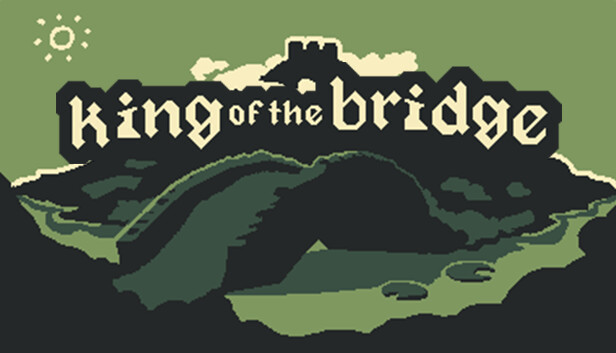
I love the concept of King of the Bridge. You want to cross a bridge. A goblin blocks your path, challenging you to a Chess game with your traversal on the line. You quickly realize that this is not normal Chess. This is goblin chess, and you’re going to lose a lot of games before you even figure out how all your pieces move. Also the goblin is a cheater. Good luck!
KotB‘s humor is on point for the entirety of its onboarding process. Gobbo dialogue is appropriately scattershot and wonky, and the rules introduced bit by bit are equally so. You’re going to lose a game and utter “oh come on” aloud when you see that the rule is “actually I changed my mind about how that one piece works”. Once it’s in the rulebook it’s gospel, and you will complete it fairly quickly, but that discovery process is genuinely compelling. A fusion of Chess and deduction, framed as dissecting a mad game designer’s scribblings across several plays, works for me on every level.
Unfortunately for our little green friend, the premise is also its greatest problem as the goblin’s game just…kinda sucks to actually play. It’s fun to figure out, and for the first 45 minutes or so it’s a joy to lose in increasingly edge-case-y ways, but once you actually learn the rules of KotB you’re left with a weak Chess variant where you periodically have to chide the gobbo for cheating at its own game. Chasing the various endings, and achieving the board states that allow you to do so, is amusing but doesn’t elevate the game on offer as much as extend your playtime a smidge. I’m hesitant to call it bad and I did enjoy it for a while, but once you run out of puzzle you effectively run out of game, and that’s a downer.
Lakeview Cabin Collection
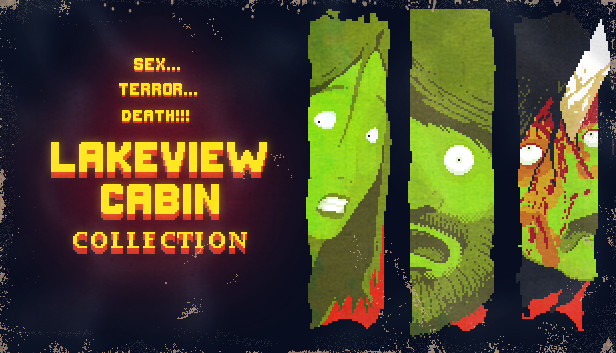
Torture Star Video is porting more horror to consoles! This time it’s Roope Tamminen’s infamous Lakeview Cabin Collection, a series of games inspired by all your favorite slasher movies. They have a few things in common (aside from the Christmas bonus episode): a familiar horror setting that mashes things you know together, a small group of characters you can swap between at will, more references than you can shake a disembodied limb at, and some of the most bonkers moon logic I’ve ever seen required to progress in a game that wasn’t published by Sierra.
Look, I enjoy a point and click adventure as much as the next guy and frankly this would have benefited from being one. Having to move each character like a janky platformer and sifting through piles of items one by one because none of them have pockets gets frustrating fast. You will often lose characters to inputs that touch the wrong intractable or don’t seem to register correctly, forcing a restart. These games originally came out almost a decade ago, and I’m inclined to give leeway to concepts this ambitious done with such little, but the frustration remains.
Even when you aren’t fighting with the controls you have to grapple with the games themselves, and they vary wildly in quality. For example, episode 3 is a relatively straightforward Friday the 13th riff until it suddenly isn’t, with killers best defeated through wonky means like getting a character drunk enough that they puke onto the path said killer will eventually walk, causing them to slip under a hazard another character can drop on them to seal the deal. This is one of the simplest solutions in the overall game. That alone should tell you whether or not this thing will delight or exhaust you.
I found myself leaning towards the latter as I got further in, as the episodes kept getting longer and more complex to the point of all but requiring a guide. Episodes 3 and 4 at least have relatively clear goals even if their solutions are anything but, you can eventually muddle through. 5 and 6 are where the dialogue-free approach starts to be a serious hindrance, with 5 in particular making zero sense for most of its runtime even after you figure out how to progress.
Please don’t misunderstand my intent here — I don’t dislike Lakeview Cabin Collection. I’m happy it got ported to modern non-PC hardware and there are a lot of horror-inclined folks I would recommend this to with minimal hesitation. I just can’t say I personally had a great time with it despite my affinity for the subject matter, and I suspect I’m not alone in losing patience with its esotericism. I do hope it does well though, if only so Tamminen considers returning to development on Lakeview Valley. Please? That game is really neat.
Code provided by publisher.
Noli
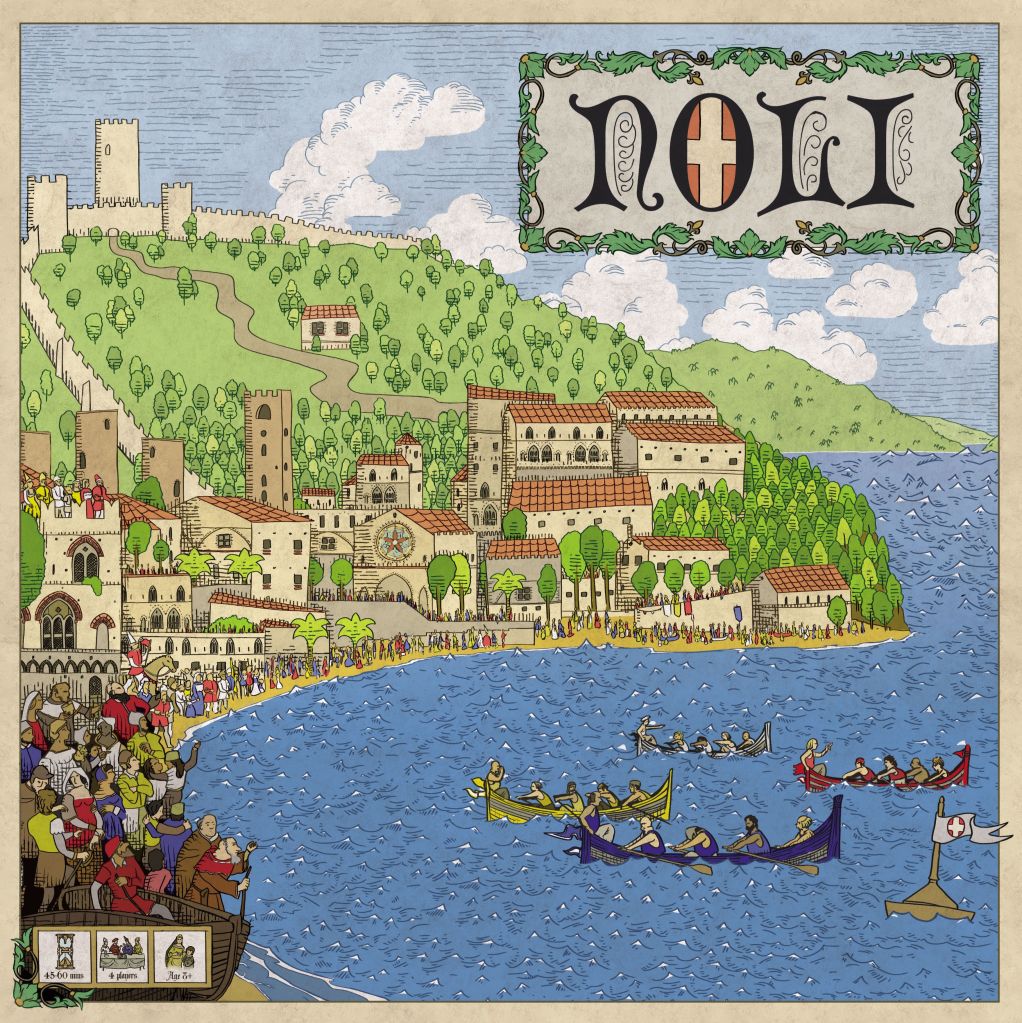
I want to open on a positive note. Noli, for all its issues, had our table laughing for much of its playtime. It’s also gorgeous, though that mostly applies to its cover. It evokes classic euro games but with far more color, and its promise of Italian boat races and district building is an appealing one.
You aren’t going to get that. Instead you have a combination of mechanics that baffled me when I read them, during play, and even more now. It all starts with a blind bid on 4 different actions. Players lose their bids whether their win or not, which is unnecessarily punitive for reasons I’ll get to later. After performing their actions everyone gets ready for the boat race, which consists of everyone rolling dice in real time trying to get 4 sixes as quickly as possible. No really, that’s it. That’s the entirety of the regatta. The most important piece of the game is just rolling 4 dice as quickly as possible.
Yet, that’s not bit that rankled me most. That would be the fishing, which completely invalidates much of what comes before. Luckier rollers get more plentiful fishing spots so they have more money for the next round of bidding, but choppier seas contain a respectable amount of nasty effects that can be played on opponents up to and including removing all leftover money from every other player’s bank. What? Why? The game quickly devolves into spending all your earnings each round (which I coined Mediterranean Budgeting because Greeks are historically bad with finances) as the risk of holding onto any cash is far too great, meaning you’re entirely at the mercy of an uncertain paycheck each round. This, in turn, means the rich tend to get richer and the poor struggle unless they roll their asses off, which is more a matter of luck than skill.
Real time games can be a blast, especially if they lean into their inherent silliness. One of my favorite games this year is Dropolter and that is just a boxed excuse to fumble with random widgets for 10 minutes. Noli, regrettably, is too rulesy and too long for as goofy as it ends up being. Some rounds essentially see no one progressing, especially if pirates come out often to ransack the town, and that feels awful. None of the individual mechanisms here are problematic and they’re even enjoyable here and there, but they lack any cohesion with each other, forming a loose patchwork that’s far from watertight. At least it looks funny enough as it sinks.
Save Room
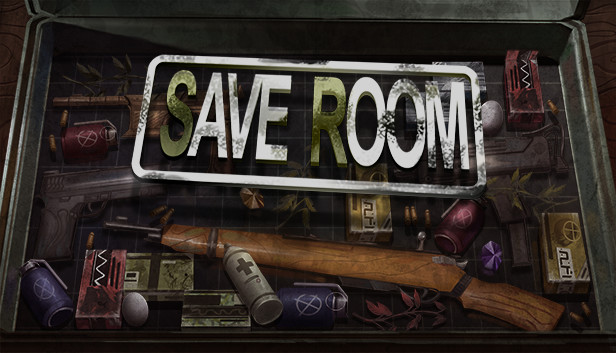
I forgot I even beat this a month or so ago. That’s not a good sign.
Save Room is a Resident Evil 4 fangame in all but name that assumes you know all the item combinations, ammo caps for each gun, etc. I do know those! And as a result the only game left is a pretty bleh set of spatial puzzles that run out within a Steam refund window.
Honestly what’s here isn’t awful, but what frustrates me is how little it matters. Inventory management is fun in Resi because it’s a piece of a far greater whole. Organizing, optimizing, figuring out what you can dump in the box for later VS what you’re willing to use now, you get the idea. There’s a ton of thought that goes into the grid fiddling. Here you’ll eat a rotten egg to hurt yourself just so you can use one more first aid spray because that’s 3 open cells you didn’t have 5 seconds ago.
You’d be reasonable to think you want a game like this, but you probably don’t. Just blitz through RE2 again, it takes about as long.
God of Rock

All Kyle and I wanted to do was play a niche fighting game at a suspiciously cheap sale price. We delved too greedily and too deep, but how could we have known? How?
GoR is a competitive rhythm game styled after fighting games. It works on precisely zero levels, and I am going to provide a list as to why:
- The note charts scroll horizontally and cannot be changed, matching no known button layout in the universe
- The game has button combinations that cannot physically be pressed on a controller, requiring a fightstick to be reasonably playable (I managed a little better on its default settings only because I played DDR on a controller as a kid because I was fucking poor. – Kyle)
- Button remapping takes ages and does not allow for d-pad inputs to be mapped at all, making some sticks unusable
- Specials and supers are done with the left stick and a button input ala traditional fighters, which must be done in addition to hitting your notes
- Every track is from the same artist and sounds nearly identical, meaning every fight feels too similar
- The UI is spread too far from the chart, meaning things like lifebars are nearly impossible to check mid-match and fights just kind of end
- Rounds have no timers, meaning they can be several minutes long as you plod through the same looping track and hit your notes
- The arcade mode is a match against every single character including yourself, culminating with a boss fight that does nothing differently
- Online play has been completely shut down a year from release, making the game completely pointless to pick up unless you wanted it for local play
There are so many more things I could spend time criticizing: the general lack of polish, the constant clunky menuing, the awful tutorial, the songs being remarkably dull for a rhythm combat game, the failure to implement custom charts despite the feature being promised by Modus/Maximum Entertainment, but I wanted to focus on why the act of just trying to play GoR is sisyphean. Even when you get it working as best it can it doesn’t come together in any kind of way. All the games I’ve covered in this piece aren’t my thing, but this is the only inclusion that’s straight up odious. It’s shockingly bad in every way that matters and several more that don’t, because at that point every load-bearing piece has been razed to the ground. I don’t understand how this came out in the state it did, but I do now see why it’s sold at 95% off.
 Reviews as Fair as a Die Roll