
Starting Sketch
I was having a conversation with some friends recently about games that you could potentially dump hours into and defend from the influx of digital pitchforks of the internet, but there was a catch: the game had to be considered “not great.” It’s easy to defend your Halo 3’s or your favorite Final Fantasy, but it’s a much more interesting conversation when you have a game like Syphon Filter: The Omega Strain. Critically panned as average and it honestly doesn’t play well, but dammit, I love that game and I will fight people who seek to slander its name. These games are always a weird anomaly, especially for reviewers. How do you punch down on a game you are for the most part enjoying? After putting around 10 hours into it, RKGK is making me answer the question.
RKGK at its core is a collect-a-thon platformer with speed-infused techniques and combat. Each level has a whole bunch of collectibles, objectives, and enemies to set up your next few minutes however you want to spin it. Your main objectives are to find Mr. Buff’s, the evil B Corp’s head honcho, controlling screens and slathering your graffiti of choice to rid Cap City’s citizens of the mind-controlling schemes keeping them in check. Valah’s movement and weapon of choice is the same paint used to deface the drab and deterring environment, as you’ll slide, slice, and dice through terrain and enemies alike to reach Mr. Buff and end his reign of terror.
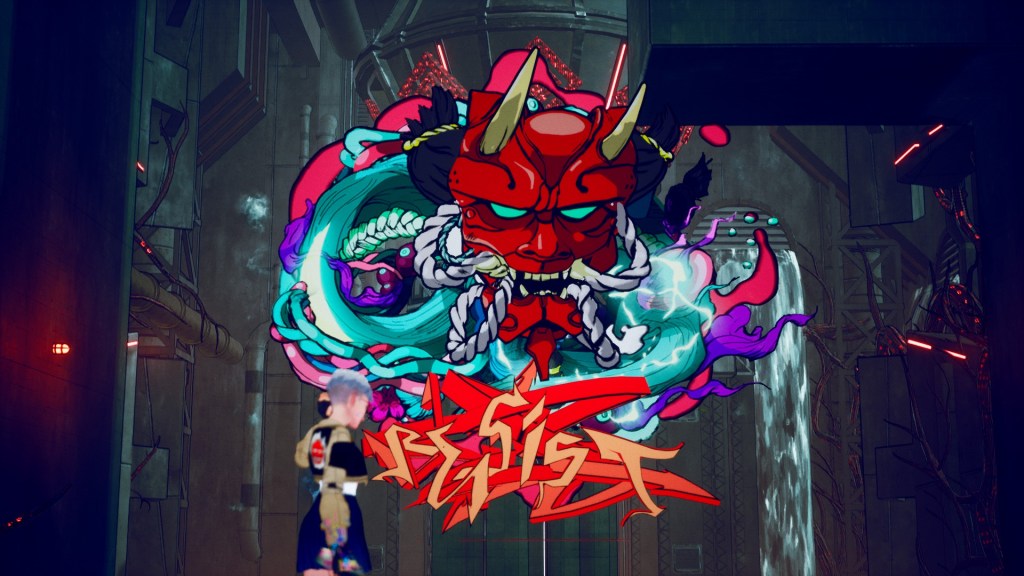
Cap City is broken down into 6 areas with around 5 levels and a boss fight in each. Levels are packed with things to collect, mainly graffiti cans to spend on murals and coins to increase your points and to spend on customizable items. The couple dozen graffiti pieces that you’ll tag through Cap City are such a visual treat. The different styles and ideas that come to life with the 3D-tooled pieces are eye-popping and are sure to wow in a few places. Tagging screens throughout the stages net you necessary progress to grant you access to boss arenas, and completing level objectives nets you Ghosts, which are a special currency that can also be found in secret areas within levels. These are used alongside coins to unlock a multitude of items like outfits, graffiti pieces, different spray colors, and much more. I really enjoyed the little easter egg nods to popular pop-culture pieces within the different colorways for Valah’s outfits and the fact you can mix and match pieces of “premium” Ghost-bought outfits with color-changed coin-bought outfits, something that should be doable in more games.
Levels start small to introduce the basic mechanics and grow to some pretty hefty stages in regards to verticality and specificity. Combat is simple, revolving around hitting with ground or air attacks, but enemies will restrict the moves you can do against them to avoid button-mashing every enemy. Comboing multiple moves together, collecting items and defeating enemies, will put Valah in Defacer Mode: a special mode that allows you to move faster and truck any enemy that stands in your way so long as you don’t take any damage. Defacer is key for the speedier objectives which we’ll go over later.

The issue with platformers that introduce a focus of speed within their repertoire is that their game can feel awfully slow when not always in 4th gear, and RKGK suffers from this. The initial run of the game’s levels is more focused on spraying graffiti, collecting coins, and finding the hidden secrets throughout, and this style of traversing the levels can be molasses-like in its pace, making 6-8 minute levels feel like full-length episodes. Combine this with a rather forgettable plot periodically interrupting, and the game’s pace drags terribly throughout its first run.
This hits even harder with some of the later levels and bosses. Their interesting mechanics get drowned out with the need for constant traffic jams of enemy placement. There are objectives such as defeating a certain number of enemies or collecting every coin in a level, but you’ll run into a few spots where your initial thought is, “nuh uh,” and maybe return to it later. With enemies that become invincible if not dealt with within a certain amount of time to constantly shooting enemies to adding in the normal grunt work and slapping them all together, this is not a test of skill but more of patience and the death tolls will rise as the odds are just mercilessly stacked on you. The final boss is especially guilty of this and is not a boss that I’m wanting to go back multiple times to master.
But once you get through the initial campaign, learn all of RKGK’s movement tech, and disregard the need to see the game through to its ending, there are points where this game absolutely clicks. The time trials provided on each level are intensely gratifying when you hit the near-perfect lines needed to obtain the gold ranking, and putting together a top-of-the-line run to achieve an S rank is a breath of fresh air knowing you did everything needed on the level at a blistering pace. Taking each level in, learning a good path, and just nailing it makes you wonder why RKGK added the collectibles to begin with when doing everything quickly is far and beyond better than its initial approach. This second layer of gameplay almost, almost makes the first part worth it, but it’s also immensely frustrating that this amount of quality in terms of mechanics and pace is buried behind what’s at surface level.

In my opinion, RKGK is not great. There’s a problematic line between adding so many things and doing them all okay when you could shave off the edges and polish what could be great. The game as a whole carries a heavy burden with the compulsive stuffing of genre staples. But I still can’t shake the urge to learn another level and try to high-tail it as fast as my fingers can allow me because getting S Ranks is a drug I didn’t know I needed. Come to think of it: those small, fleeting, colorful moments surrounded by the melancholic mediocrity enveloping it all is very on the nose if you ask Valah about her time in Cap City.
 Reviews as Fair as a Die Roll