

Bump ‘n’ Grind
Does the name “Hydlide” mean anything to you? There’s a good chance it doesn’t, and I’d say that’s a shame but I’m not interested in revoking gamer cards for such minor offenses. After all, there hasn’t been an entry in the series since the distant past of 1995, and that last entry was a particularly ugly remake for the Sega Saturn. They were massively influential RPGs for their time and often referred to with deference, but it’s rare to hear someone say Hydlide is their jam these days. Now it falls to indie devs with sufficient nostalgia and passion to carry the torch, and carry it they will.
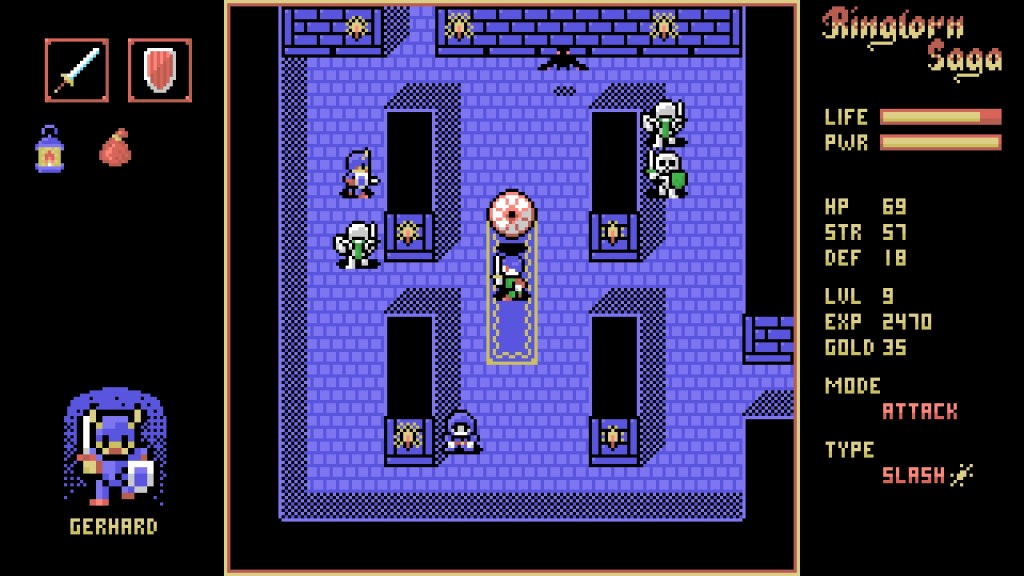
Enter Graverobber Foundation’s Ringlorn Saga. There’s a plot, but I’ll give that about as much focus as the game does and move on. You are a knight. You have a quest to slay a bad man. Get to work. In an era of gaming that’s happy to be overly verbose, I respect the commitment to the old school ethos of being a video game first.
What do you actually do? You enter a screen, much like Hydlide or the original Zelda, which promptly fills with enemies. You engage, or don’t, and eventually touch the side of the screen, scrolling everything to the next one. Repeat until you are the hero of the land. This can feel a bit jarring if you’re accustomed to modern mapping, but it ends up creating a strong sense of place as your mental map fills in tile by tile.
Make no mistake, this isn’t just a game borrowing a retro aesthetic. Everything hurts in Ringlorn Saga. Basic enemies can easily wallop you for most of your health if you get careless or complacent as everything scales with your level. You can never afford to stop paying attention. Be ready to gearshift to defense mode whenever you aren’t swinging your sword, memorize your opponents’ weaknesses, and learn how to shimmy around your opponents. Float like a butterfly, stab like a knife.
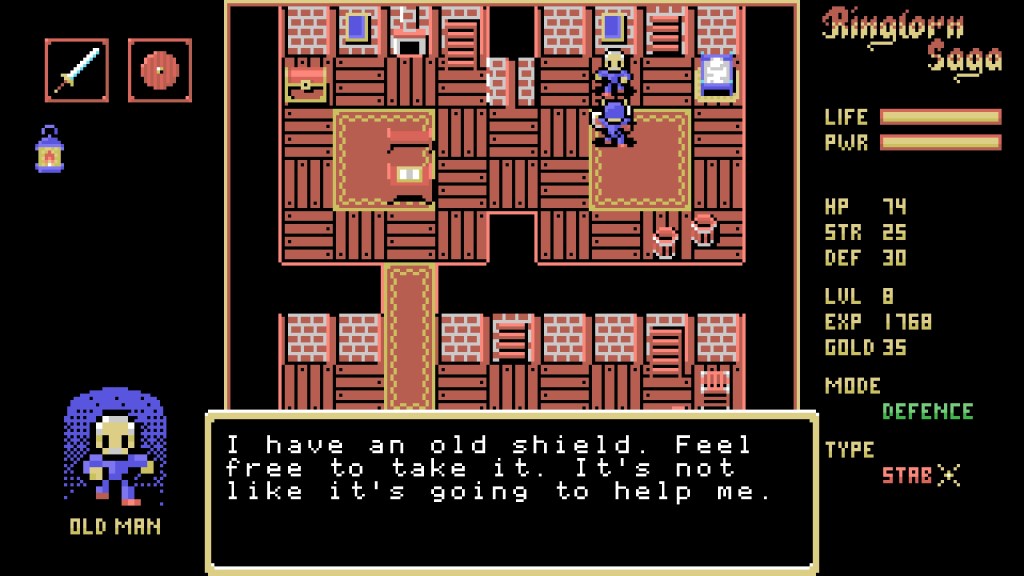
The game’s challenge comes almost exclusively from its combat, and for as Hyd-like as it is (which is to say simple) it works quite well! Enemies are weak to one of your three types of attack, and you bump into them to attack, no button press required. This would feel overly simplistic were it not for the solid rogues’ gallery that keeps you on your toes. Enemies all have their own behavior patterns but will break them to bother you, often meaning you can find yourself cornered if you don’t keep track of everyone on screen, which you’ll also need to do to ensure you prioritize targets in the right order. Suffer not the wizard to live lest they cast buffs on the whole screen or nuke you from across the room.
Ringlorn Saga is mostly open-ended. There are plot quests that are effectively linearly gated, but most of the side content is accessible from the word go. I ended up dungeoning to the point where I found most of the game’s items and equipment well before making any “real” progress, which meant some of it was definitely harder than I was meant to be doing, but swung the other way when I finally showed up to the main dungeons in a fresh set of armor and one-shotting basic foes. I didn’t run into another challenge until the end boss, who either lacks weaknesses in general or perhaps folds to the one spell I didn’t manage to get. It took a few tries, is what I’m saying, but I got there.
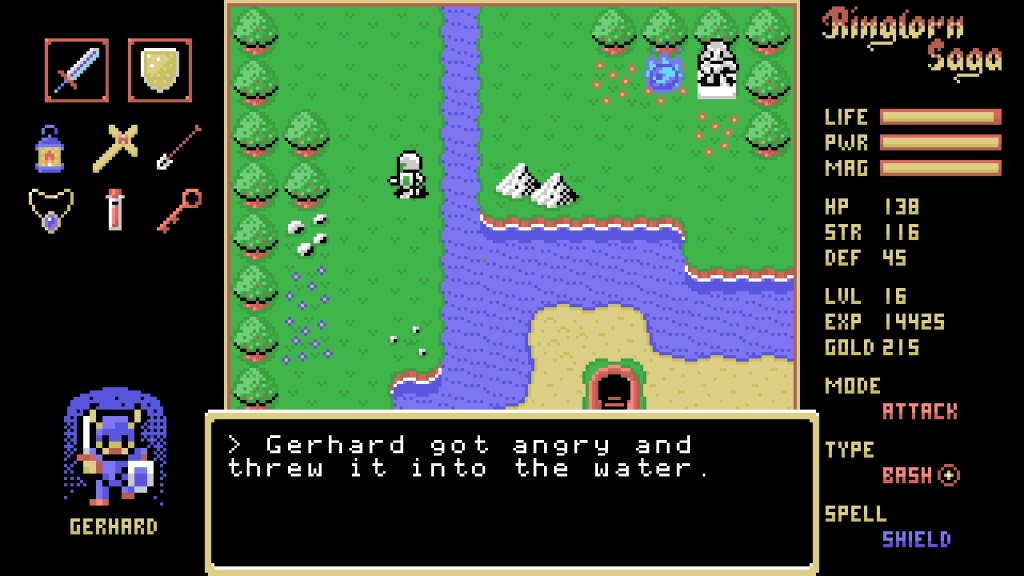
Ringlorn Saga is a damn fine way to spend 6 hours. It’s not a game I’d recommend to most people, largely because I bet if you took a break and came back to it you’d find yourself hopelessly lost for at least a little while, but if you stick with it until completion it’s plenty enjoyable as a throwback with some modern QoL features. What really excites me is the potential of its upcoming sequel, Ringlorn Saga Gaiden, as this is a rock solid foundation to build more complexities onto. But regardless of how that turns out, this still manages to be a quality mini-RPG that succeeds in paying tribute to those that inspired it.
Now if only Graverobber Foundation would let me pitch Virtual Ringlorn Saga.
 Reviews as Fair as a Die Roll