

Don’t Believe The Lies
Visual Novels are given a long leash on under-the-surface shenanigans when telling stories. When you look at titles like Doki Doki Literature Club, Cooking Companions, and YOU and ME and HER: what was one thing very sharply, and sometimes abruptly, becomes another. So when you’ve run the block a few times like myself with visual novel plots that yank you like a bad showing at the Apollo, you can understand my initial interest and subtle mental concern with Black Tabby Games’ Slay the Princess.
On the surface level, you are an unnamed protagonist tasked with slaying a Princess locked away in a cabin hidden within the woods. With your every move narrated, you reach the cabin (or maybe you don’t?) doors and enter the premises. You grab the blade left for you (or maybe you don’t?) and venture within the confines to reach the basement. There you hear a faint request of presence by the Princess, an acknowledgement of who travels down the steps to save her. You steel your nerves and don’t respond (or maybe you do?) as you finish descending into the basement to see your Prey or Prize. You are tasked with the simple question: do you follow the Narrator’s telling of this story and slay the Princess, or do you let human emotion seep into play and further examine the task at hand?

No matter what decision you make, and there will be plenty of them, you’ll be rewarded with a walking, talking Content Warning as this game takes more turns than a full rally event. But before we even hit these warnings (and spoilers as it is very hard to explain much of this game without digging into that territory), the depth of content within Slay the Princess is a magnitude venturing near full-priced, $60 VN territory. Each scenario comes with almost double-digits worth of questions and responses, allowing your inquisitive nature to learn every tidbit of information of instances that you are definitely not prepared for. The amount of directions that are available is so extensive it needs a flowchart to structure, and each and every word is fully voiced.
The Narrator, and the many many voices in your head, is voiced by Jonathan Sims of The Magnus Archives fame. Sims does such an amazing job not only providing a soothing, natural tone to The Narrator (and all the branching bits you’ll eventually put him through), but also lending his vocal talents to the many different Voices of the Protagonist you’ll encounter (and pick up) during your travels. The amount of vocal work put into these roles is such an expansive undertaking that the fact he knocks it out of the park with all of them is astonishing. The same can be said for his counterpart, Nichole Goodnight, as the Princess. The range of sad, exposed, and frail to daunting, demanding, deadly, downright scary: there is a lot to be seen and heard within Slay the Princess and both voice actors carry their pages with gusto and pride that is absolutely needed for the work presented to them.

I’ll dip into some spoiler-esque topics now:

As said above, when diving into Slay the Princess, the grand scheme in regard to its plot is expansive to the point where seeing the totality of the game requires several playthroughs. But the plot gets wild, big, and wildly big very fast and it can be kind of a mess to keep up with. What starts as a simple request from your Narrated partner fleshes out to be a multiverse of multiple princesses of different monikers that all have the ability to end the world they’re residing in. This is because You and the Princess are godly aberrations set within an interdimensional vacuum, and you need to kill her in order to save the worlds around you from being torn apart from the Being that disguises itself as the Princess.
It’s loony and if I missed on some parts, it only serves to strengthen my point that this game throws a lot at you very quickly. This is not to say that the plot isn’t well-thought out or not written well: it’s just for a piece of horror that goes this gonzo, it absolutely needed more time in the final third to explain itself better. The ship does set itself back on course because you have the ability to replay and backtrack through the game, as is expected with nearly 24 Princess Endings to reel you into the game’s 5 Real Endings (side note: I really wish the “Good” Ending had more to it as doing the right thing feels like a copout), but having the Narrator’s explanation of what is happening be limited to a few questions before forcing the player to continue is an odd choice when you’re already expecting the player to replay the game. Don’t hide knowledge to further explain your endgame!

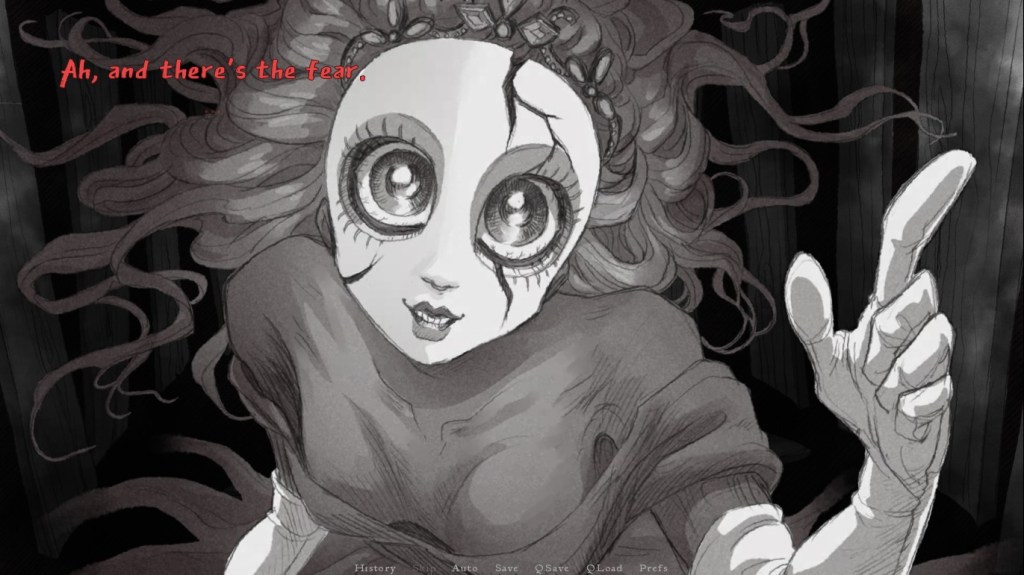
This leans into more of a personal gripe than a true negative, but games of this magnitude really need a visual cue to what has already been chosen in previous runs. Technically you can get this when the “Skip” button becomes present (only after you’ve picked your choice, remember to save!) but with the amount of branches you’re allowed to see within each playthrough and the total amount there are to witness alongside picking the correct replies within the mountain of choices you’re given, it’s very tough to see everything the game has to offer without physically writing down which paths you’ve taken, and I can’t think of many times a visual novel going out of its way to lower the chances of its player seeing everything it’s worked so hard to create ever being out to be a good thing in the end. There’s a lot of crazy things that happen in Slay the Princess, it shouldn’t be this hard to find them all.
Despite this, Slay the Princess really shows how far the Visual Novel genre can be pushed. It’s well-written and impeccably voiced. It’s terrifying, somber, hilarious, and downright confusing, but it’s such, such a good time. If you’re looking for a completely out-of-your mind narrative adventure, and can stomach what you find behind each door, there’s few options better than a couple afternoons slaying the Princess. Or saving. Or leaving? Your choice, really.
 Reviews as Fair as a Die Roll
I can’t wait to get into this game. Thanks for the review!
LikeLike