

The Game Awards came and went on Thursday, December 7th, showcasing a litany of new video game announcements and creating a hefty amount of buzz and clicks around the gaming world. I’m all for enjoying childhood memory sizzle reels, games that literally have no release date, and everything in between. But for an award show that is designed to honor and celebrate the vast world of gaming and the thousands of developers that contribute their careers for these larger-than-life moments: there’s less and less during The Game Awards that feels pointed to this.
The Game Awards has been a year-end passion project for creator Geoff Keighley that received its first ceremony in 2014, but the foundation of The Game Awards came from a TV past. Geoff worked alongside the now-defunct SpikeTV during their ten-year run of hosting award shows of their own, dubbed the Spike Video Game Awards from 2003-2013. Much like The Game Awards, the VGAs presented at the end of the calendar year a couple dozen awards given out to the industry’s best and brightest upon a national stage.
A year before its eventual cancellation in 2014, Spike wafted an air of disinterest in the award show and swapped the format (and showcasing) of information provided in the presentation. Fans lauded it more as a commercial care package for sponsors and advertisements than a celebration of video games as a whole. Hell, the trophy was this weird monkey statue with a cigarette and a joystick. Geoff in 2017 said, “I took [award shows] seriously, and I think part of the thing [about] these other shows was that [they were] just entertainment. I get that, but to me it’s not about which comedian we can get to host the show. If you want to see comedy, you’ll see it elsewhere. Our show is about celebrating game creators.”

But looking back to Thursday, is it? I won’t dismiss it all knowing there were plenty of spots that showcased AAA, AA, and popular A titles coming down the pipeline, and with a show that peaked at 103 million views during last year’s event, this is close to the best place to announce an upcoming title based on view count and potential virality alone. The problem is as more and more companies want in on the action, the main reason we’re all here becomes less and less important.
Look. At the main talking point of the night, less than 10% of The Game Awards this year was awards-related. That’s including introductions, nominee reading, award selection, walking down to the stage, and speeches. Less than 35 minutes of a 3 ½ hour show. Neil Druckmann and Asad Qizilbash, accepting the award for Best Adaptation, were the only people not to get played off by the “Please Wrap It Up” music. Of the 32 awards presented, only 10 saw the stage. If you won an award you were given 30 seconds to talk. What else took up that time?
Advertisements for Discord, Google, and Samsung. Celebrity tie-ins. More product placement. More advertisements. Geoff wanted to make an award show that under his wing would shift the spotlight back on the game developers that brought us memorable experiences and the players that kept video games as one the top entertainment commodities in the world. Meanwhile in 2023, we neglected to denounce the mass layoffs crippling the gaming workforce despite massive profit gains within AAA conglomerates and we told Larian Studios, makers of Game of the Year Baldur’s Gate 3, to Please Wrap It Up while they thanked the many people who contributed to their game, including some who had recently passed away.
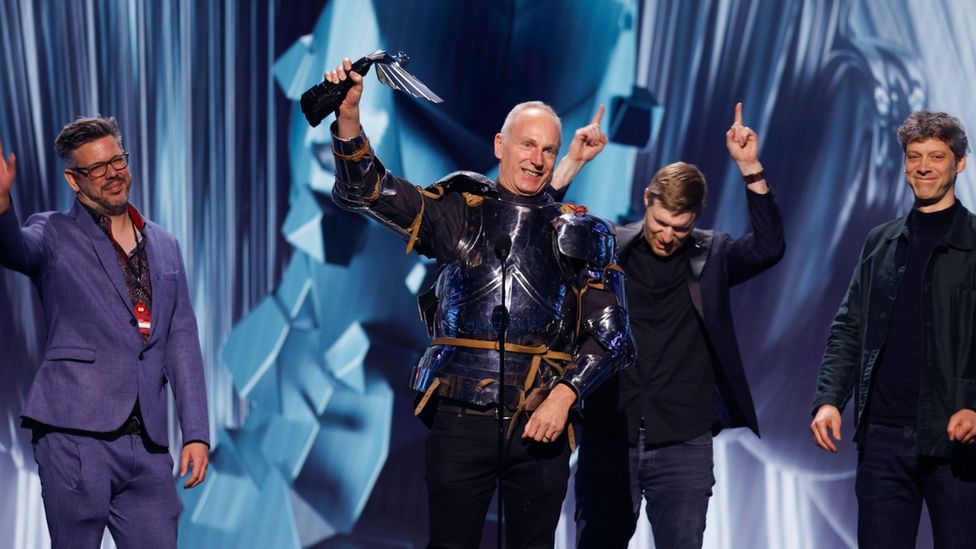
Geoff said in 2014, “The Game Awards is a special event to honor the achievements in gaming, our talented developers and devoted fans,” and “The Game Awards will celebrate our collective love of games and the passion we all hold in our hearts for this incredible entertainment medium.”
Ten years later? You might as well change the trophy to have, “like a funky monkey with a joystick and a cigarette or something.”
 Reviews as Fair as a Die Roll