

Pillar of Salt
Let’s not bury the lede: we have been consistently playing Sea Salt & Paper for most of this year. It’s become our default 2-player pick to play over tea, hitting the perfect balance of hand management, gambling, and tactical decision making all in a tight maybe-20-minute playtime. It plays 3-4 players fine, don’t get me wrong, but SS&P is a head to head game first and foremost and I’ll be reviewing it as such because that’s where this game shines brightest.
I want to take a moment to appreciate the production of this thing: a snug-fit lidded box just big enough to hold the cards and rules, enough player aids for everyone, and some absolutely gorgeous origami art on every single card. I am not an artist and could not begin to guess how this was produced. Staged photos? Extremely convincing digital art? Some combination of both? All I know is it looks lovely. Every card warrants an extended look and would make for some fantastic wall art. The game is nothing but cards, but man, what great cards.
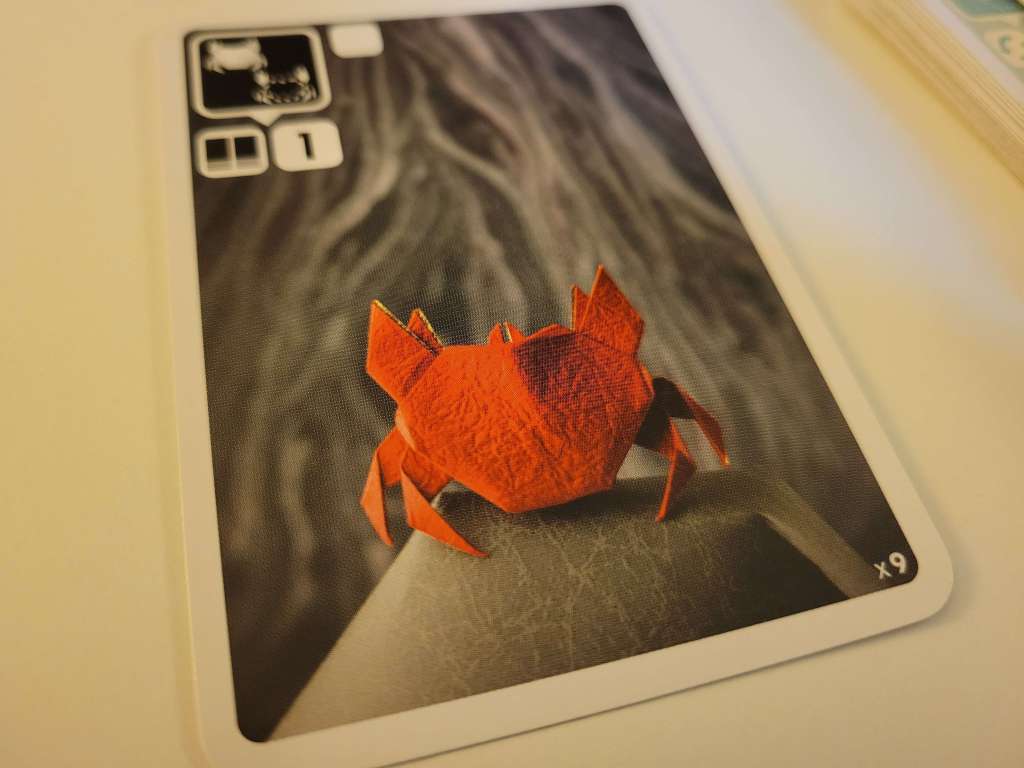
What do you do with those cards? You draw them, one way or another. Turns couldn’t be simpler: take two cards from the top of the deck, keep one in your hand, and discard the other into your pick of the two discard piles. Alternatively you can simply take the top card of either discard, making the card beneath available to your opponent. The former lets you dig for combo pieces that’ll trigger all kinds of scoring conditions that we’ll get to in a minute, the latter gets you a sure thing as opposed to chaff that doesn’t advance said conditions. In summary: you can get first pick of new cards but give your opponent access to one of them, or take a card with a certain benefit but make your opponent aware of your grand design. High risk/high reward VS low risk/low reward.
And what’s on those cards? Points! Well, mostly. Almost no cards are just worth points outright, they all require some sort of combined effect. A pair of fish here, a set of seashells there, a fancy card that grants points for every copy of a different card you manage to collect. It’s set collection, but with more finesse than typically required to actually pay off. Then the game adds some spice: a pair of sailors that are technically a set but are worthless unless you get both, requiring you to find two needles in the haystack. A shark that can be paired with a swimmer for a point and the chance to yank a card from your opponent’s hand, potentially wrecking their plans. And my personal favorite, the mermaids, who take the background color of your cards into account and score equal to your most common shade. They also allow you to shoot the moon and win the entire game if you get all 4! You will almost never see this. That said, I’ve done it. It rules. I recommend trying for it despite all good sense.
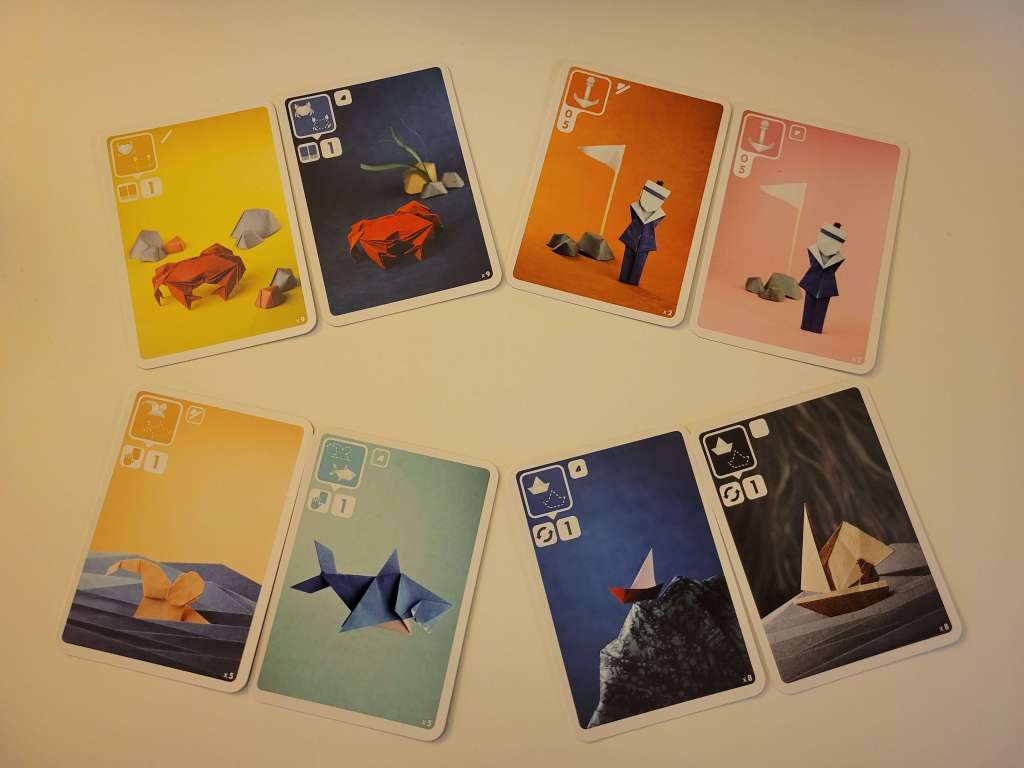
The greater aim here, beyond the tricky maneuvering in the draws, is in how you stop playing. When your cards are worth at least 7 points you can simply call Stop to end the hand! Both players score, cards get reshuffled, easy peasy. But you know, you’ve been getting a lot of points. Surely more than the other player, right? So why not style on them and call Last Chance instead of Stop, giving them one extra turn to beat your total? If your gut is correct and they don’t manage to overtake you, you’ll score your points with a bonus and your opponent gets a pittance, losing most of theirs. One small problem: if your opponent scoots right by you this is reversed, with them getting heaps of sand dollars and you only receiving silt pennies.
Describing SS&P as a set collection game that works well with 2 players is accurate, but doesn’t fully capture the tension it produces. The game is a high wire act between two extremely jealous acrobats who both just happened to bring a pair of scissors to work. You may or may not use them in any given hand, but the threat of the snip is ever-present. It’s this dynamic, reminiscent of the classic Japanese game Koi-Koi, that keeps us playing it again and again with no intent of stopping. When my partner and I are at the table it’s common for one of us to voice the incomplete question, “Sea Salt?”, and I cannot recall a single instance of either of us turning it down.
—
So! That’s one of our favorite games of 2023 summed up. But SS&P has done quite well, and games that do well tend to see expansions. A game consisting of a whole 64 cards can only really sustain a proportional expansion, which is why Sea Salt & Paper: Extra Salt consists of a whole 8 new ones. The question is, are these a nice addition to the ecosystem or a set of invasive species?
I still don’t like to bury ledes so in summary: no. Extra Salt is not offensively bad or anything, but it’s wholly unnecessary and creates some ripple effects on the broader game that we didn’t care for. I’m going to spend more time talking about what the card effects do here than I did in the original, partially because there are so few of them, but mostly because I want to focus on the problems they create.
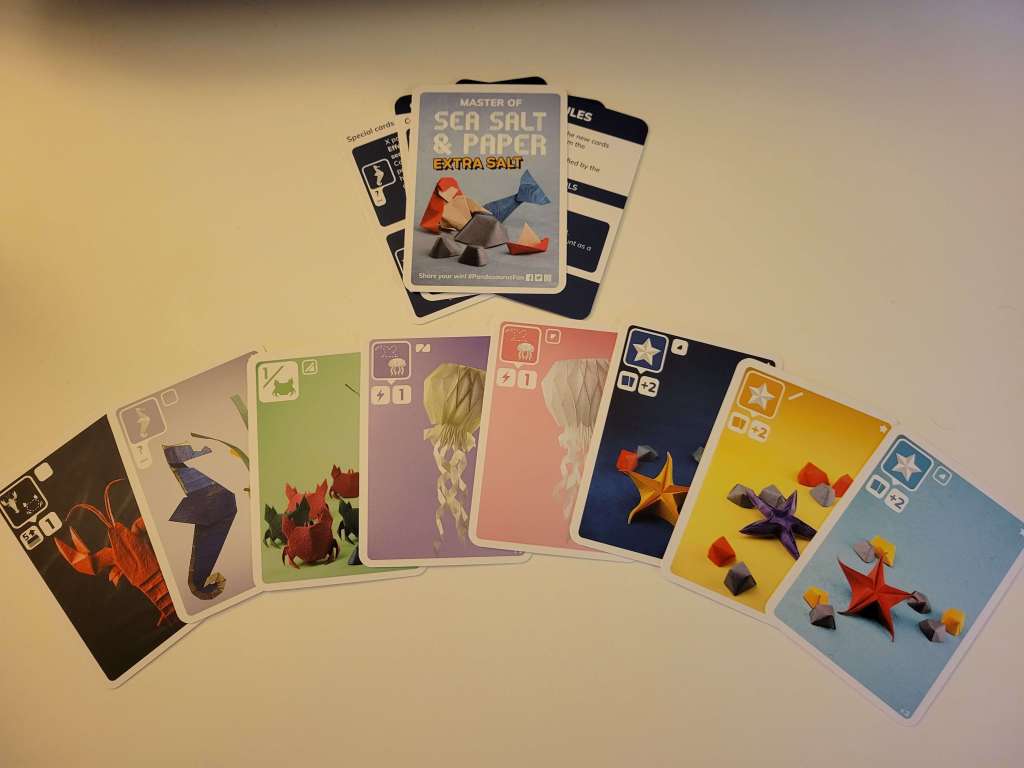
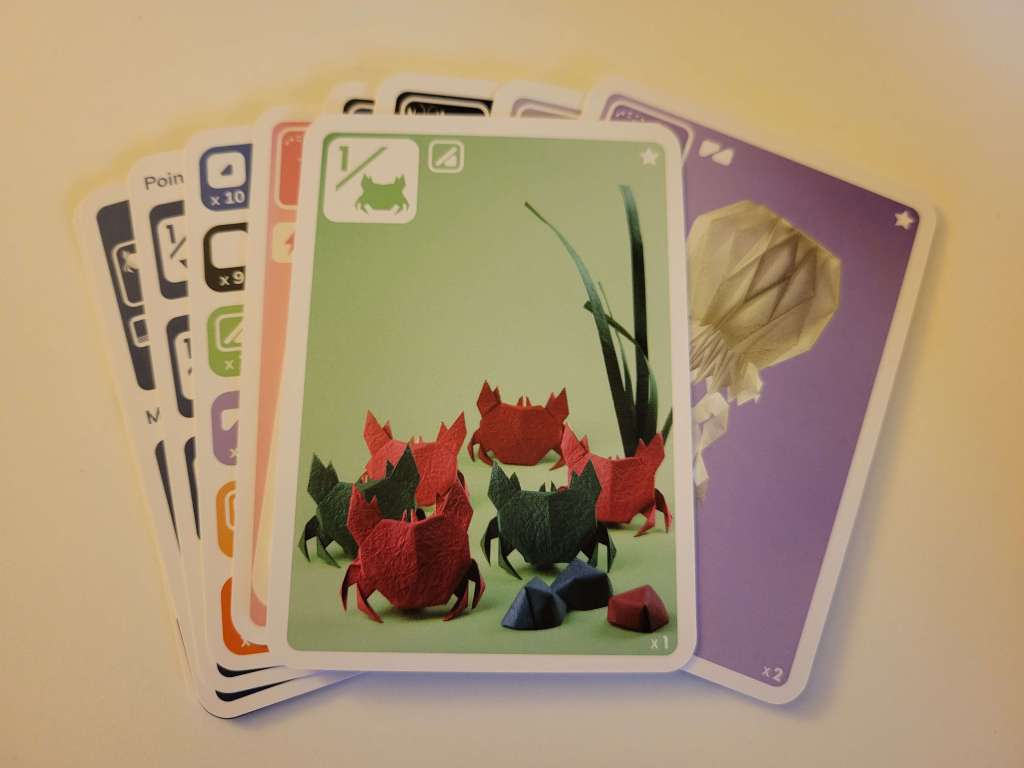
Let’s start with crustaceans. There’s a card that gives you a point per crab! This is fine, though crabs are already very strong and seemed to have been balanced by not having such boost potential in the base game. There’s also the lobster, who can be paired with a crab to allow a player to draw 5 cards, pick 1, and shuffle the rest back in. This is one of the strongest effects in the game and has absolutely no downside for whoever draws this single card. Bit much. Not a fan.
Then we have the jellyfish. These are an alternative to the shark that allow an attack when paired with a swimmer. Instead of attacking a player directly jellies serve as a more equal opportunity strike, forcing all opponents (meaning 3 people with a full table) to simply draw 1 card on their next turn. This is…boring? It’s not a full on loss of a turn, but it’s also uninteresting and feels far less impactful than choosing a winning opponent. There are also no additional swimmers added, which means fewer sharks trigger, which means attacks on the whole are less fun.
It’s the starfish and seahorse I like the least. Starfish can be grafted onto a played pair, removing their ability and granting additional points. Again, while useful, stripping effects from cards is inherently unexciting. Last and vey least is the seahorse. It is very simply a wild card for set collection, allowing you a significant point boost for anything you could possibly want. Remember those two sailors I mentioned? Now there are 3. Or it can just be another seashell, or whatever you have going on. There’s always an application for this thing, so you should automatically take it at every opportunity, and considering the base game’s focus on difficult either/or choices this is a very, very poor addition.
Overall, I could see adding the crab booster to our games in the future. Maybe. But when ⅛ cards gets our seal of approval I’m unable to recommend adding that sprinkle of Extra Salt. Sodium is a killer, don’tcha know!
—
Don’t let this salty aftertaste put you off of trying the base game of Sea Salt & Paper. This is a phenomenal pack of cards that we’ve found reason to return to again and again with no loss of enthusiasm. It wins friends everywhere we take it regardless of player count, but it’s at our coffee table between the two of us that it truly peaks. This is a trip to the beach that we intend to keep taking for the foreseeable future.
8/10 (base game)
Extra Salt expansion: Not Recommended
A copy of the base game was independently purchased for review. Expansion copy provided by publisher.
 Reviews as Fair as a Die Roll