
Solid as a Horse Stance
Not too long ago in my Mid Game Roundup I commented on Oink Games’ iffy hit rate. Particularly in recent years, a lot of their boxes have felt more concerned with cute art and presentation over game design. You’ll have to forgive me for not being thrilled with the likes of Quickity Pickity or Dokojong. Despite this, I’ve had my eye on one that only just got localized for a couple years now. Tiger & Dragon is a departure from their broader catalog in several key ways: it doesn’t fit the Oink box profile, it’s by far their most boujee production yet, and most importantly it’s a genuinely excellent game.
We should start with some history. T&D is a reinterpretation of an 1800s Japanese game called Goita, a 2v2 hand shedding game traditionally played with Shogi pieces. That game holds up decently despite a handful of funky rules, with invalid hands that must be immediately discarded after a deal, strange piece hierarchies, that kind of thing. In terms of play it’s a deceptively subtle experience, with players simultaneously trying to set up their partners and screw over their neighbors. What truly makes it work is the simplicity of its play when you get your head around the Shogi symbology: play a tile to block your opponent (match their play), then tactically attack with one of your own. Clack, clack, pass.
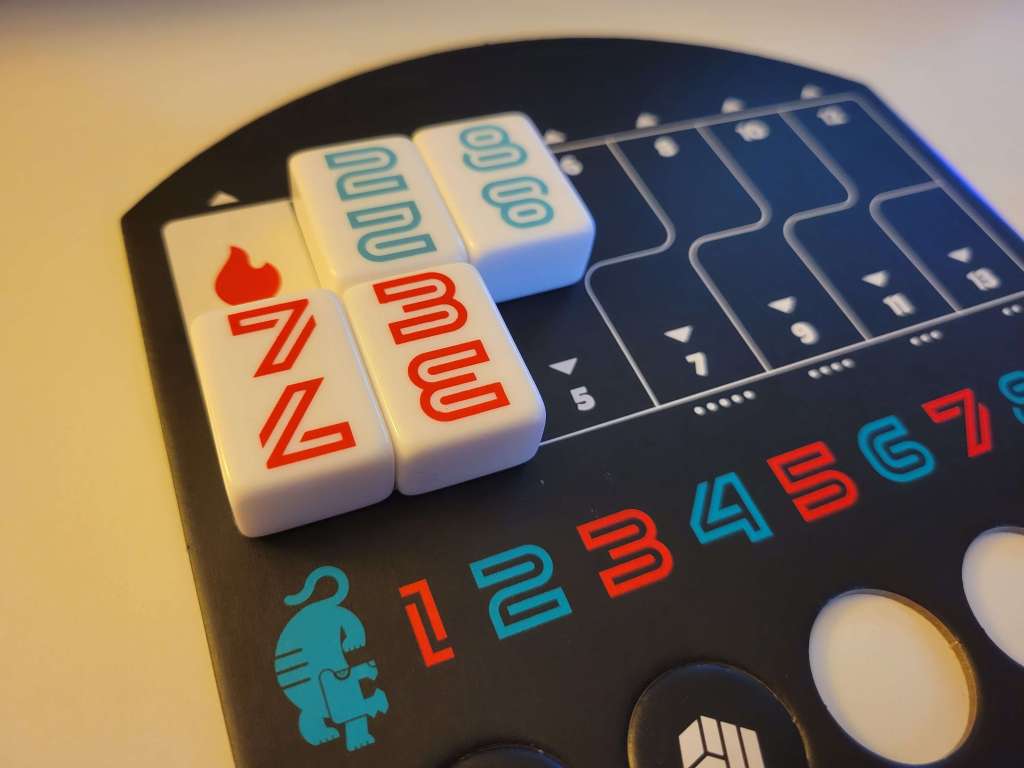
T&D builds on this foundation in several notable ways. Most obvious are the Mahjong-esque tiles, giving players even chunkier pieces to clack down. Very satisfying. There are some player boards, and while they aren’t strictly necessary they help keep the table organized and legible. The tiles themselves have made the jump from Shogi to more broadly understood numbers with a pyramid distribution: eight 8s, seven 7s, a single 1, you get the idea. There are also exactly two special tiles, the titular tiger and dragon, but we’ll get to those later. The game now supports a range of player counts, going from 2-5 while still supporting the traditional 2v2 game. Finally for segue purposes, we have the battlefield cards. These are what elevates the game from “Goita riff” to its own duo of beasts.
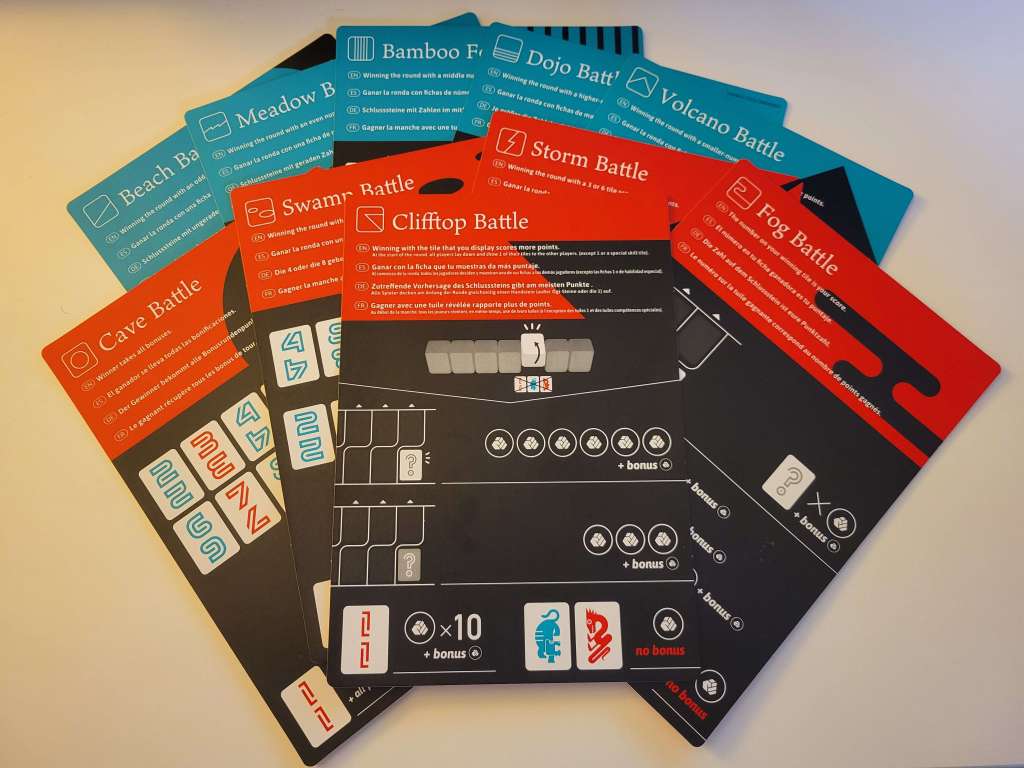
The 10 battlefield cards set the scoring conditions for the whole game. A hand is won by whichever player or team empties their hand first, and the dealt battlefield offers a table of point payouts that vary depending on what tile the winner plays last. This creates a widely varied range of priorities for your table. In one game you may want to go out with less plentiful low numbered tiles, whereas in others you may want to go high. The more complex battlefields offer more interesting twists, my favorite being Clifftop Battle, which forces all players to reveal one of their tiles and grants a sizable point boost to anyone who can go out using that exact tile. Given that the game relies on a pretty significant amount of card counting (which the boards and numeric distribution help make much easier) that’s a pretty tall order, but hitting a called shot into the uprights always feels incredible.
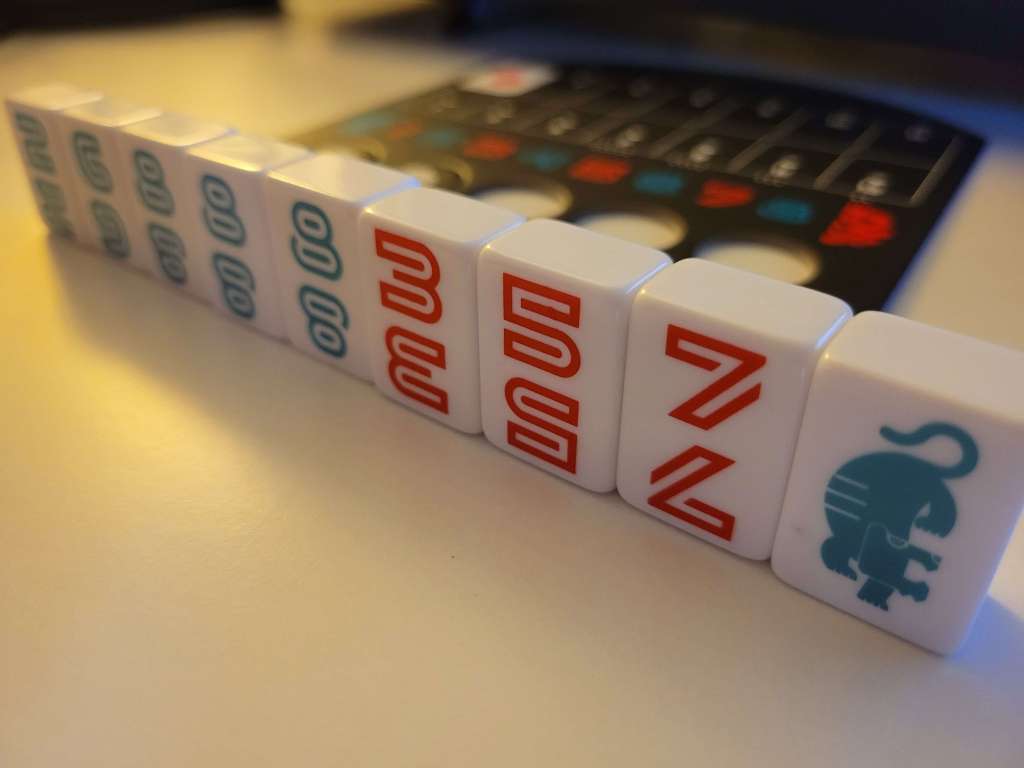
There’s a consistent variable that warrants mention. No matter what battlefield you’re fighting on, two things are always true: winning with a Tiger or Dragon is terrible, and winning with a 1 is the absolute best outcome. The Tiger and Dragon tiles are wilds for even or odd numbers respectively, making them amazing for getting a hit in but equally easy for your opponents to block. Since it’s too easy to go out with these in any given hand you’ll only ever get one point and are disqualified for bonuses, which are earned by playing tiles nobody manages to react to. The 1, by contrast, can only be played last if you manage to engineer something equal parts crafty and risky. Since there’s only 1 of it you can never use it to block (unless someone just played the Dragon, but that never happens). That means you’d need to play your second to last tile, get all the way back around the table unbothered, and then proudly flip your 1 for the win as your opponents grant you your due respect. It’s the game’s moonshot, as challenging as it is rewarding, and it is glorious.
I know that despite my enthusiasm this review has likely portrayed the game as stark and mechanical. It’s a bit tough to add a lot of color to cards/tiles and numbers sometimes, especially in a game that offers almost no illusions as to what it is. Sure there’s some line about kung fu fights on the back of the box but…come on, it’s numbers on tiles. What I want to make sure I convey is just how satisfying this game’s ebb and flow is. Players constantly hemming and hawing on when to interject and take a swing of their own, trying to get one over on the rest of the table as everyone’s options dwindle, almost as if their stamina is fading over the course of the hand. There is something to the martial arts set dressing, sparse as it is.
More importantly though, it’s just a damn fine way to spend time with friends. It’s an incredibly rare thing for a game to achieve so much with so few rules, but despite the ease of grasping it there are strategies and subtleties galore to explore. When do you hold a tile despite being able to block? What do you attack with and when? How do you set yourself up for a high scoring turn on this game’s battlefield without hurting your chances? If you’re playing 2v2, how do you set your partner up for success without dooming yourself? Can you figure out what your opponents are likely holding and exploit it for bonus points? There’s plenty to noodle on, yet it’s also a perfect choice for playing on mostly-autopilot while enjoying a cup of coffee and a chat. That’s a level of flexibility and versatility few games can achieve.
Appropriately for a game based on a traditional Japanese go-to, Tiger & Dragon feels classic. After dozens of plays I’ve only gained more enthusiasm and affection for it, finding myself increasingly excited for our next session, itching to clack some tiles and outwit my friends’ fighting styles. On the back of the box Oink claims that this is a game you “can play 1000 times”. I’ll cop to scoffing at this when I saw it, dismissing it as hyperbole, but more than any other game in their catalog Tiger & Dragon is deserving.
 Reviews as Fair as a Die Roll