

Splintered Cell
The PS1/PS2 era provided a golden age of stealth titles: Metal Gear Solid and Splinter Cell come to mind when you want to rank high in this category, but the genre flourished across the era. Requiring stealth to navigate almost insurmountable odds elicits an adrenaline boost that hits different levels than frantic hack n’ slashes and pounding FPS’s. It requires less focus on fast reflexes and more of a constituted patience, and that change of style can completely provide different experiences between similar games.
So for the ever-present indie scene, what could be a perfect fit for nostalgic PS2-era stealth n’ shoot than to recreate it within present day materials? For Antonio Freyre, Stealth is a well-worn path in game development experience. Previous titles like UNDETECTED and The Chameleon show experience and intrigue, capturing weirdly interesting ideas and implementing them into a smaller-genre’d mechanic. The apple has not fallen far from the tree as we get Antonio’s 3rd game of 2023 with No Sun to Worship.
Normally I have a paragraph dedicated to the game’s plot, but I’ll be honest: I’m at a loss as to what is really being told here. On the surface, you are a person/robot who has been tasked to punish those in need of punishment. The punishable are surrounded by loads of guards in various metallic, futuristic, desolate areas. Your task is to punish all that need punishing and exit, but how you get from Point A to Point P is entirely up to you.
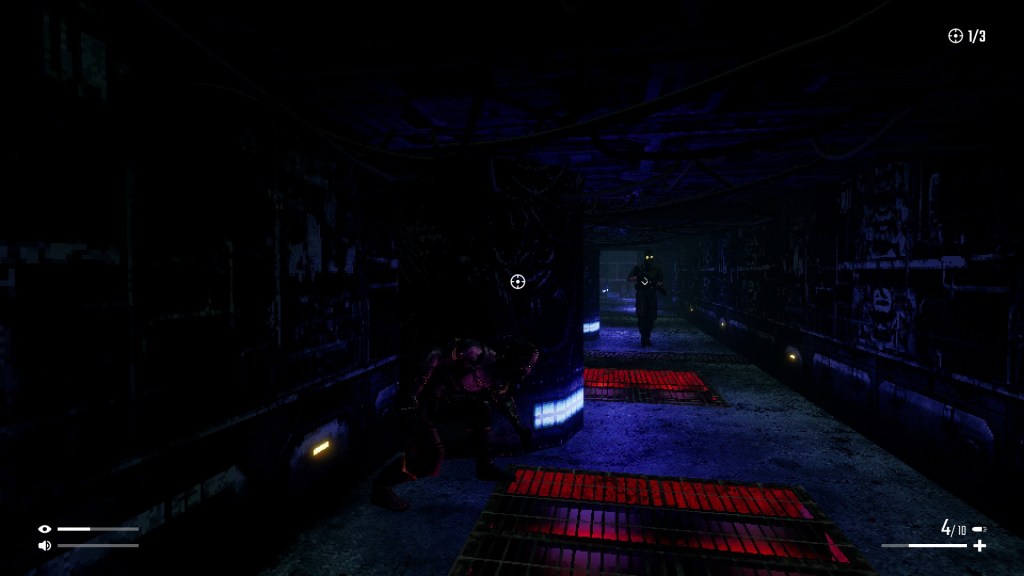
The first level acts as a tutorial. The two places you should look immediately are the light and sound bars in the bottom left, and your ammo count and HP bar in the bottom right. No Sun to Worship handles its detection by how much noise you’re making and how visible you are to your enemy. Jogging through each area will induce a consequential amount of noise, whereas gently tilting the analog stick while crouched will make you near impossible to hear. You’re given two different guns and nothing else: a silenced pistol for stealthy incursions and an automatic rifle for when you haven’t been as stealthy as you should’ve been.
Guards come in light and heavy ranks. Light enemies carry less health and the ability to be headshot while heavy enemies hit harder and cannot be headshot, though they can be killed instantly via your backstab finisher. Guards don’t have to be killed in order to complete your objective but levels are much easier with open lanes devoid of living enemies. You can instantly kill an enemy with a backstab so long as they are unaware of your presence. A vital part of keeping your noise down is the ability to mask your footsteps at the cost of a HP drain. To combat this risk/reward option, you can “absorb” enemies for a small HP gain that will also dematerialize bodies so they cannot be found. The higher the rank, the more HP gained, and your marked enemies that need to be punished will provide a full bar of health.

Health management alongside risk/reward is a fantastic base to allow riskier moves to remove guards while not allowing an abuse of the riskier moves. No Sun to Worship wants you to prioritize which moves are worth potentially dying for, and when those moves allow you to beat a level it achieves the rush that only stealth-based games can provide; a job well done that only you will ever know about. The only caveat with this is that No Sun to Worship is a risk-punishing game, and if you risk it wrong you will lose a lot of progress.
Levels do not have checkpoints. In each of the game’s 6 levels is expected to be done in one life and largely devoid of enemy contact. Levels involve tight corridors and numerous guards that hurt a lot. Most enemies will take you down in 2-3 bursts of shots, and if they have line of sight on you they are not missing. They have perfect aim (you very, very much do not have this luxury) and will follow you an incredible distance if seen and alerted. If you die, back to the start of the level you go. This requires you to be very patient, learn enemy patterns, and know when the best time to kill a guard will be. This also puts you on constant full alert so seconds feel like minutes and each level being around 15-20 minutes long is mentally exhausting. So when you happen to get caught in the corner by a guard or spotted if they turn around too fast or you didn’t tag them previously (done by aiming at a guard for a quick second) and don’t know where they are since footsteps are your only indicator, you will get shot, and you will die. And it’s back to the start of the level you go again.
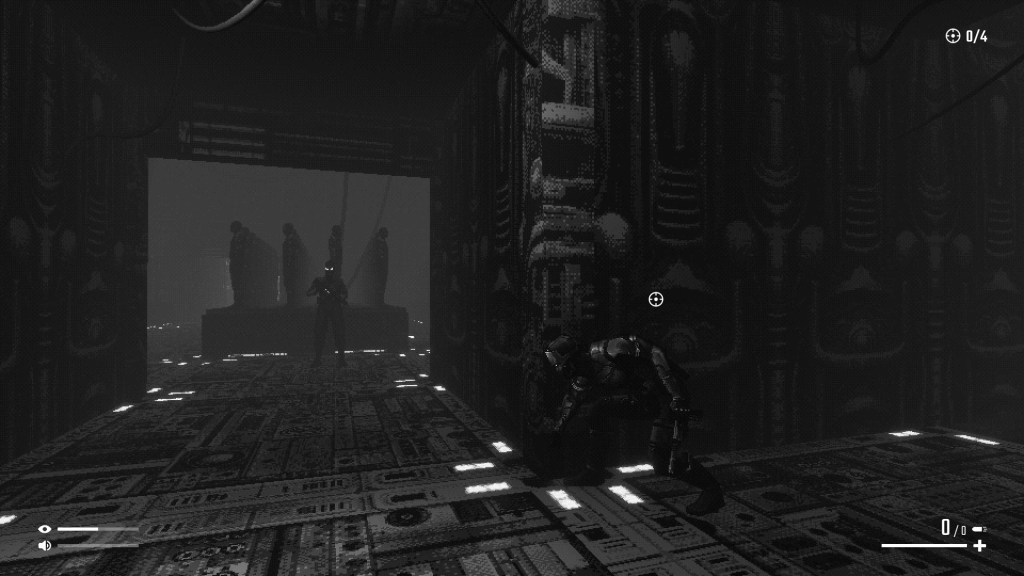
The difficulty can be described as brutal but fair, but I found the expectation to be perfect hurts the replayability of the overall game. Failure provides information for the next run, almost like a roguelite title, but failure with such drastic punishment can be exhausting and frustrating to the point where finishing a level is less of a fist-pumping triumph and more of a sigh of relief that you never have to do that again. Additionally, there’s a Hard mode that increases the rank of enemies so there are more heavy ranked enemies around, but why would I submit myself to that nonsense if Normal difficulty had me putting the game down for the day because I was done replaying the same mission over several tries?
I also felt the crumb-fed plot hurt the natural progression of the game as I never really decoded what I was doing in the first place. Antonio does state, “Pay attention to the symbolism and messaging,” but that’s impossible to do as looking around any area and admiring any symbolism is less time for me to memorize enemy patterns and thus increases the chances I’m going to have to do the whole level again. If there were gaps within the tension to show the symbolism and messaging, I think the message of No Sun to Worship would’ve been more understood.
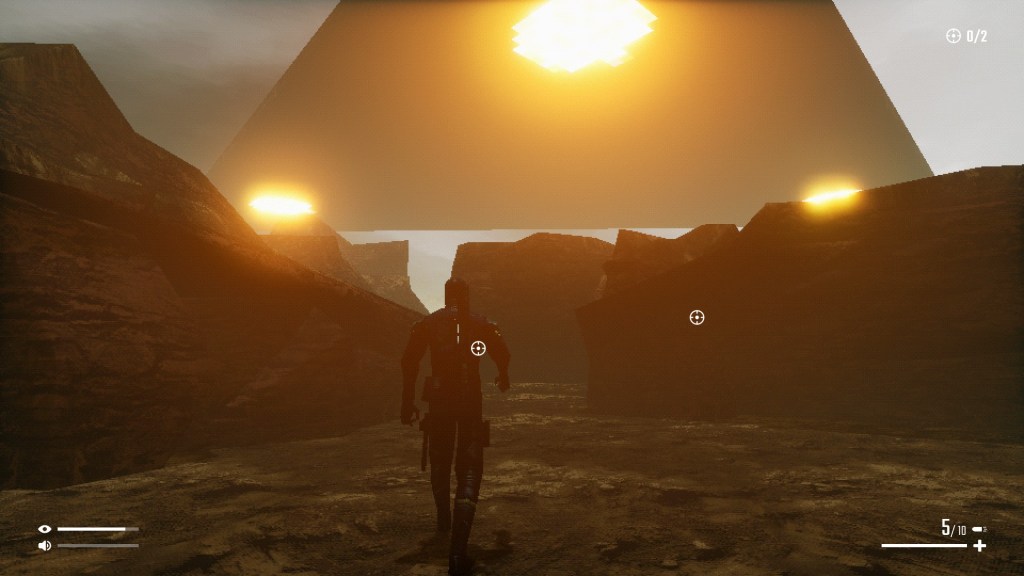
I know people with a tolerance for punishing mistakes and the will to achieve perfection might embrace No Sun to Worship more than I did, but my 3 hours within this project were tough. The gameplay lovingly encapsulates the sound/see design that put Splinter Cell on the map in the 2000s and embraces a tension-building pace that doesn’t release until the level ends. But the brutal penalties for making just one mistake are miserable and hurt any interest in navigating or learning or enjoying anything outside of the mission, and only the mission, and the game’s demand to do it right no matter how long it takes.
 Reviews as Fair as a Die Roll