
Clash of Averages
Man, you wanna talk old games? Let’s talk old games. You might have heard of Might & Magic, a relic of the gaming era with roots dating to the MS-DOS years of the Mid 1980s. A cosmic blend of medieval fantasy and science fiction that has captivated audiences with 10 main titles over the course of 28 years. While the IP was owned by New World Computing and the 3DO Company for most of its lifecycle, the assets of these companies were split and sold to the highest bidder. Ubisoft took the reins of Might and Magic in 2003, spawning an entirely new franchise under the similarly-named moniker of Heroes of Might and Magic, as well as various spin-offs. We’re gonna talk about one of those today: Might and Magic: Clash of Heroes.
Released on the Nintendo DS in 2009, Clash of Heroes follows 5 of the 8 factions within the Heroes of Might and Magic lore: Haven, Inferno, Sylvan, Academy, and Necropolis. Five children from these factions: Godric, Aidan, Anwen, Nadia, and Fiona have their lives torn completely from their normality when a mysterious Demon Lord seeks to disrupt the alliances of these factions and use the turmoil between neighboring regions to drown Ashan in chaos. Seeking the Blade of Binding, the powerful artifact needed to open the demon world of Sheogh, and looking to intervene against Urgash, the Dragon of Chaos, the five are spread amongst the territory of Ashan to stop this diabolical plot from achieving its final destination.
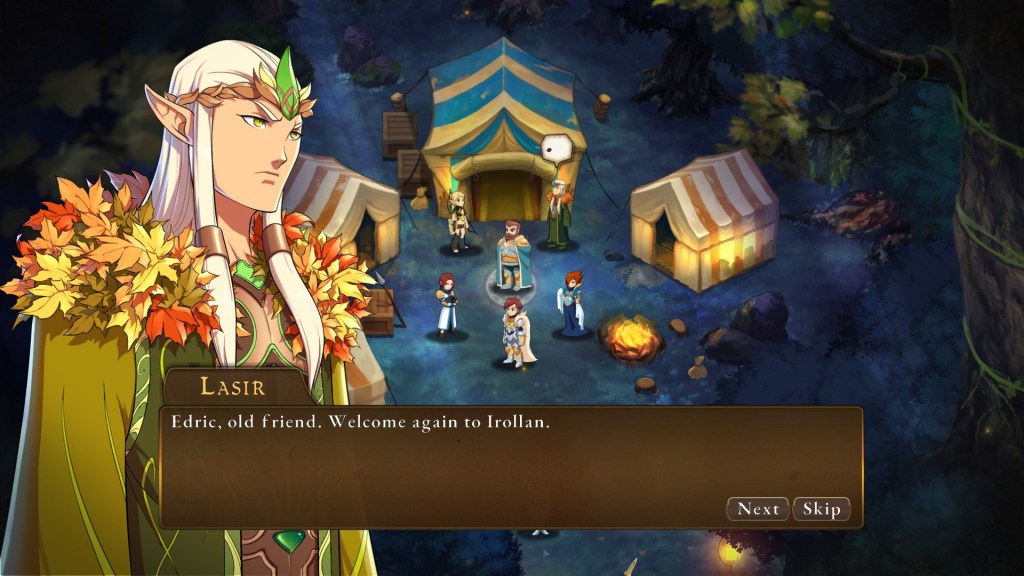
What we have in front of us is the Definitive Edition of Clash of Heroes. Pieced together by Dotemu, the new edition provides redrawn artwork, quality of life improvements, a retooled Online mode, and all the previous DLC slapped together into one package. Full disclosure: this is my first foray not only into the Clash of Heroes title, but Might and Magic in itself, so if there are any inconsistencies within the plot, I will probably miss them and am judging the entire game upon fresh, green eyes.
Battles are smashed together in the art of turn-based RPG, and Puyo-centric, Match-3-esque Puzzle Fighter. Characters go into battle with 3 slots of small units, which can be mixed and matched to suit playstyles, and up to two special units, which I’ll call Double Units and Quad Units for ease of understanding going forward. Damage is dealt by matching three small units in a vertical line followed by a set turn amount before they march into battle to fight whatever is in front of them. Defending your territory is done by matching three or more small units in a horizontal line that’ll build walls that will mitigate incoming enemy attacks. Walls can be built to higher levels with additional units made into walls behind it. The basics of this system is vertical-offensive, horizontal-defensive.

But there’s so many more shenanigans that come with the battlefield. Each team is given three moves per turn, but doing combos that activate multiple moves allot you extra turns. The fancier the move, the more turns you’re refunded. You can delete single units on the field to have vertical or horizontal combos land and that can refund your turn. Doing “T” and “L” connections will provide walls and an activated attack pattern while also refunding your turn. If you can make the Tony Hawk Special Move Noise multiple times in one go-round, you can run that combo until your board looks angry.
This also leads into your special units. Remember the Double and Quad Units? Stacking two small units behind a Double Unit will activate them, while stacking 4 small units in a 2-by-2 square behind a Quad Unit will activate those. These units carry bigger health and attack points as well as powerful passive and lasting effects after attack. It’s worth defending these to allow a devastating attack after their cooldown time finishes, as well as shifting the battle to your opponent having to deal with the gigantic issue now in front of them before the timer ticks down.
Each faction in campaign and multiplayer have their specific units that all carry different styles of play (use one style of unit 3 times to stack the same attack or spread out evenly to diversify your violence portfolio) and each character comes with an Ultimate move, powered up by MP that’s gained by taking and dealing damage, that plays to each faction’s strengths. Some feel more powerful than others, but all Ultimates carry a significant change in momentum once used, except at times for the dice-rolling luck-based Lightning Strike.

The amount of movement, combos, and strategy piled into a simple Match-3 style puzzle fighter is staggering. Each game provides a fresh look at a faction’s strategy and I’ve spent hours running matches with friends with each character and continuing to learn small intricacies with each play. This game will continue to be a mainstay within my rotation of games as it just provides that good good scratch of that itch of strategy and serotonin-making of outclassing your opponent but never feeling like the game cheated you out of a loss.
The campaign cannot carry the same distinction. Clash of Heroes boasts a massive 20+ hour story (it took me about 22 hours to complete) spanning 5 main areas. Each chapter follows a different character within a different part of Ashan, starting each character and their units at Level 1. You progress the story through meeting main NPCs, learning more of the mysterious Demon King and his nefarious plot, as well as engaging with various side quests sprawled about the boardgame-like setup.
Side quests are marked with a Silver icon (with main quests wearing Gold), and are there to provide you EXP to level up as well as resources like Iron, Gold, and Crystals. These resources are used to buy Double and Quad Units once you’ve unlocked them in their respective areas within the campaign world. Side quests boil down to three styles: Puzzle Quests, Bounties, and One-Offs. Puzzle Quests are pre-set boards that are won by defeating every enemy unit in one turn, using combos to refresh turns and allow extra moves to proc every unit. Bounties have you sent off to find various NPCs of advancing difficulty and battle them for whichever reason the Bountyman provides you. One-Offs are exactly that, random NPCs providing you some reason to battle, and your job is to oblige.

These side quests may be side quests, but you would need to do these. Shoot to do nearly all of them. Why? Because the campaign pulls no punches and does not play nice after the first area, which is used primarily to give you a rundown of how the game’s mechanics work and what strategies to look into. Enemies will be a higher level than you, and you’re consistently expected to be punching upwards at your opponents. The issue with this is some main and side quest enemies are just too high of a level to even compete against, so areas then boil down to walking around aimlessly for the random battles to pop up (which those can even be over your level), or banging your head against the wall until you get a favorable drop of units.
But be warned, the AI will get some absolute filth for their “random” drops. I don’t want to sound overly salty, but enemies will get gift-wrapped drops of units that allow them some extensive combos to naturally “increase” the difficulty. This is already done by most opponents being over-leveled to your own, but getting bombarded by perfect combos whilst activating their Double and Quad units that are more powerful than yours will deal with multiple Game Overs, and it won’t feel like a skillful defeat. To circumvent some of this hill-climbing some areas will implement objectives outside of draining HP bars to achieve victory, but most of these had me wishing I could just slog through a HP bar instead.
The inspiration for the puzzles are a neat idea: ranging from hitting two buttons behind premade walls, to hitting two specific units running around the map behind other units. But each puzzle presented it supplies a small issue that makes the experience unbearable to play. Need to hit two buttons behind walls? You must hit them within 2 turns or they revert and the game neglects to tell you this. Need to hit those units running around the map? They do not telegraph their moves and can jump upwards of two lanes each turn. With vertical attack patterns taking upwards of 3 turns to fire, most puzzles turn into a game of pure luck that the enemy you need to hit is within firing range, or wasting 15 minutes not knowing a prime piece of knowledge for the objective because Clash of Heroes just didn’t tell you ahead of time.

Completing these side quests, puzzles areas, and everything in between will net you Artifacts, which are passive buffs specific to your character. Each faction has 10 artifacts that can provide substantial upgrades to specific units to better bolster a specific playstyle, to giving buffs to specific actions like deleted walls yielding MP for your Ultimate, to giving you a second life if your HP hits 0. You’ll also unlock special Double or Quad Units for use in campaign and multiplayer as well as extra characters when you complete an area. Running through the campaign is your only way of unlocking them for use in multiplayer, so get ready for the long haul if you want to use the interesting things with your buddies.
Each area finishes with a final boss once you feel confident enough in your units and level, and these were the highlight of the campaign for me. Bosses carry a massive HP bar and highly powerful but telegraphed moves that put your knowledge of your board to the test. Each boss was challenging but fair and a long fought victory helped wipe away some of the grime of getting to the battle itself. The final boss is absolutely crazy powerful and I had to take a cheesy, cheesy way combining a specific artifact and a lot of walls to defeat it, but none teetered into the purely “unfair” category.
With Capybara Games’ intention to provide unlockables through the campaign only (you are granted 1 artifact per 5 levels gained in multiplayer, but with there being over 50 artifacts, good luck with that), you are purposely guided to run through the story and everything it has stuffed in these five areas. But the spoiled AI, teeth-grating puzzles, and the fact the campaign is just way, way too long for what it is makes going through this quasi-mandatory experience a dreadful slog. Which is a shame considering how ridiculously fun the battle system is.

Which is why most of my time has been spent within the multiplayer. 1v1 battles play out as the battles did in the campaign, but with each player picking a character and their respective units. When you’re not dealing with artificial difficulty and letting the created system shine, it’s incredible how fun this game can really be. Add in a couple friends and play the 2v2 for a mind-bending but intensely satisfying experience as each teammate controls a preset amount of units and must work together to create devastating combos. It’ll rack your brain but it’s so, so dope making combos work alongside a partner.
I’ve put around 33 hours into Clash of Heroes and after this I will certainly be back to put more in. The Match-3 style breeds a satisfyingly high skill ceiling with a pick-up-and-play-friendly floor that will gladly greet anyone finding its way into its world. But having to tackle an overly stuffed campaign poisoned with artificially high difficulty and most of the game locked behind every stuffed nook and cranny of poorly executed objectives almost soils the entire experience.
 Reviews as Fair as a Die Roll