

Mediohardcore
Extremes make for easy writing. Excellent games are easy to praise, and terrible ones are equally easy to dissect. The truly difficult games to break down are the mediocre ones, games that neither inspire love nor loathing to any degree. Most of them function well enough but suffer in terms of enjoyability one way or another, as is the case with the 3 games I’m dubiously “featuring” today. Call them capsule reviews, writeups, or a blog post if you’re feeling uncharitable; these are just some opinions on games I really did not want to do extended pieces on. Let’s take a journey through the middle ranges of the Pixel Die scale, shall we?
——————————————————————————
CHALLENGERS!

Fresh off winning a Kennerspiel des Jahres, Challengers definitely has a lot going for it. Excellent production even if the tiny playmats are a bit overkill, fun art/premise, and a genuinely solid attempt at adapting autobattler video games to the tabletop. And after a play or two it certainly charms! It’s only on further inspection that things start to fall apart a bit.
Challengers is a game entirely about its cards. Cards are acquired, shuffled, and played in a manner much like War, just flipping and resolving. Barring certain card powers you’re making all of your choices between matches rather than during, and that perfectly matches the cadence of video game autobattler superstars like Super Auto Pets or Mechabellum. The problem is those games have considerably more interesting units than Challengers has cards.
Approximately half of each faction’s set is made of blank cards that simply contribute a number to your ever-changing running total. These cards are boring. Even the single “advanced” faction included in the box still has the same ratio of interesting : boring cards. This doesn’t stand out in your first couple games as you’re still coming to grips with the ones that actually have text, but the more you play the more it stands out, especially because the larger numbered cards actually perform very well on average as they don’t rely on being flipped in the correct order to provide full value.
This kind of sucks! I understand needing some basic filler in the starter decks, and maybe even including a few cards that are simply A Number, but the sheer amount of them beggars belief. A game like this should be full of surprises, with silly flips leading to laughter and plenty of room for combos. Sometimes it is that game, but other times your draws provide nothing more synergistic than slotting a big number with the right color.
Much like Dominion for deckbuilding or Puerto Rico for role selection, I find myself far more excited by the idea of future games Challengers will inevitably inspire than Challengers itself. Even the upcoming Challengers 2 has already shown in card previews that the ratio of interesting : boring cards isn’t changing, so it isn’t going to get much better. There is something of interest here, and it does warrant a play or two to see how it works, but I would not look here for anything more than a mechanical base to something greater that doesn’t yet exist.
5/10
——————————————————————————
GRAIL CUP
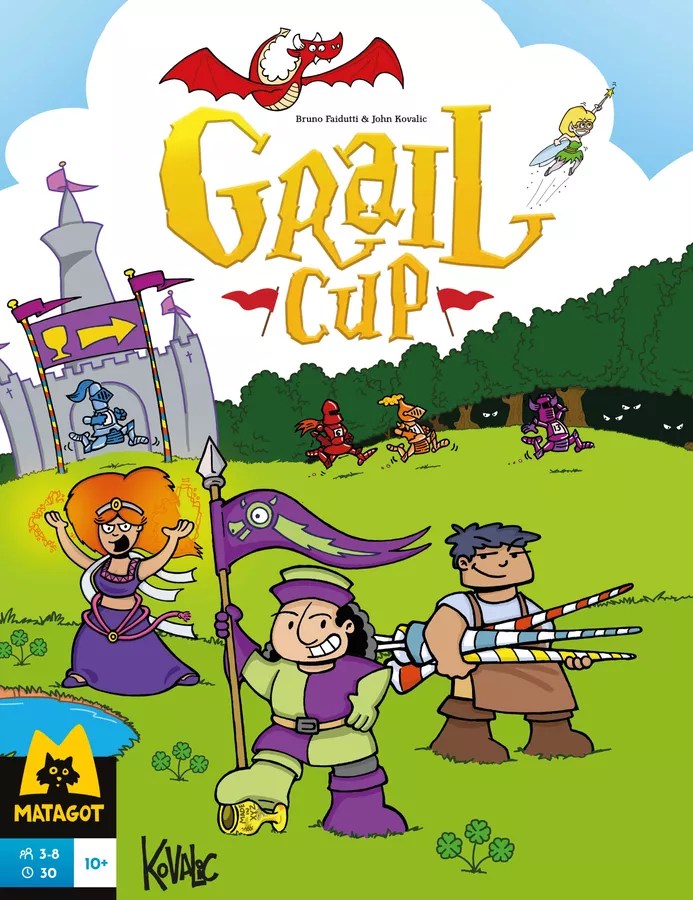
I am a pretty big Faidutti fan but will readily admit that he has never been the most consistent designer. For every Mission: Red Planet or Vabanque there’s an HMS Dolores or Secrets. Role selection is typically his bread and butter, often chaotic but rarely dull. Unfortunately Grail Cup is a rare case.
Your turn consists of drafting a role that’ll give you something to do when its number comes up, but the roles are interactive and impactful to the point where you cannot reasonably predict anything, even at lower player counts. This is not inherently problematic but it suffers in comparison to all of his prior role selection games, which allowed a lot more room for cunning choices and doublethink. For the Faidutti-familiar, imagine a version of Citadels (or more specifically Lost Temple) that achieves a level of chaos so high that you just stop caring.
So what does that actually translate to? Just picking a card with decent movement and hoping for the best, basically. Given that the game is a race to the finish line where the relative positions change constantly, you can only really do so much to affect your destiny. Having cards removed randomly at lower player counts before each draft means that some roles will often lack counterplay, and that’s the cherry on top of a low-agency sundae. Grail Cup feels like more of a ride than a race and it’s not the most exciting ride I’ve been on.
4/10
——————————————————————————
TOWN 66

I still enjoy some Sudoku from time to time. There’s something inherently satisfying about putting the right thing in the right place, especially when you’ve deduced that it couldn’t go anywhere else. Town 66 gets partway there, but in trying to adapt it to a multiplayer push your luck puzzle it stretches too little over too much.
That’s a lot of descriptors without a lot of detail, so let me elaborate. Town 66 is a game about placing unique houses in a grid. Houses have two identifying characteristics: their color and their shape. Because everyone in this town is a bit of a jerk, they refuse to share any common traits with any other house in the same row or column. Sudoku, in fewer words, except your opponents are also architects.
Oink Games has a history of making games that are more cute than functional, be it for having comically tiny pieces or being more of a cool idea than an actual game. Town 66 is the latter. There’s a concept in this game of intentionally not drawing up at the end of your turn, permanently reducing your hand size, because it positively impacts your score at the end. In theory this should be a source of excitement, of tension! In practice it just makes the game less fun every time you do it. You have no control over the tiles you draw, which means that your rapidly dwindling selection can just fall apart at any moment. And again, you have to do this if you want a reasonable chance at winning. Games should be about doing the fun thing (in this case perfect placements), not whatever this is.
I’m increasingly disillusioned with Oink as a publisher. This isn’t a “for every good there’s a bad” situation either, their hit rate is like 25%. Startups, Mr. Face, and arguably Fake Artist are clear standouts, but even that last one’s a bit of a reach when it’s basically a public domain game stuffed into a tiny box with tiny pens. There’s a reason Oink enjoyers spend more time admiring all the cute boxes on their shelf than actually playing their titles; most of them get forgotten a year later. Town 66 is one of those. This town’s a flyover.
 Reviews as Fair as a Die Roll