
Solid Tier
There was a time, not too long ago, where we thought Zachtronics was over. This has ended up not quite being the case, as now Zach is making games again as well as producing them under a new label with friends: Coincidence. As in these games are “designed by Coincidence”. More publishers could do with a sense of humor. So I took it upon myself to play that, then figured why not try them all?
I am a relatively casual Solitaire Enjoyer. I know enough to win at Klondike pretty often, and also that I enjoy Tri-Peaks more. My bona fides on this are not the strongest but I do enjoy a deal accompanied by a cup of coffee. Zachtronics solitaire games, of which one was included with each of his mainline titles until they were eventually bundled together, are often engaging enough that my coffee goes cold.
First a few words on the collection itself. Put succinctly, it’s slick. I love the simple, clean presentation and the soundtrack that had absolutely no reason to go as hard as it does. Each game, as well as the menu, has its own completely unique style and it helps give each a stronger sense of identity. You likely will not find a better looking way to play lots and lots of solitaire than this.
An additional note: I mostly played these on mobile, and the mobile port for this collection is not the greatest. Some of these games will give you eye strain on a tiny screen. I eventually acclimated but you probably want to play this on PC if you have the option.
Honorable Mention: NERTS! Online
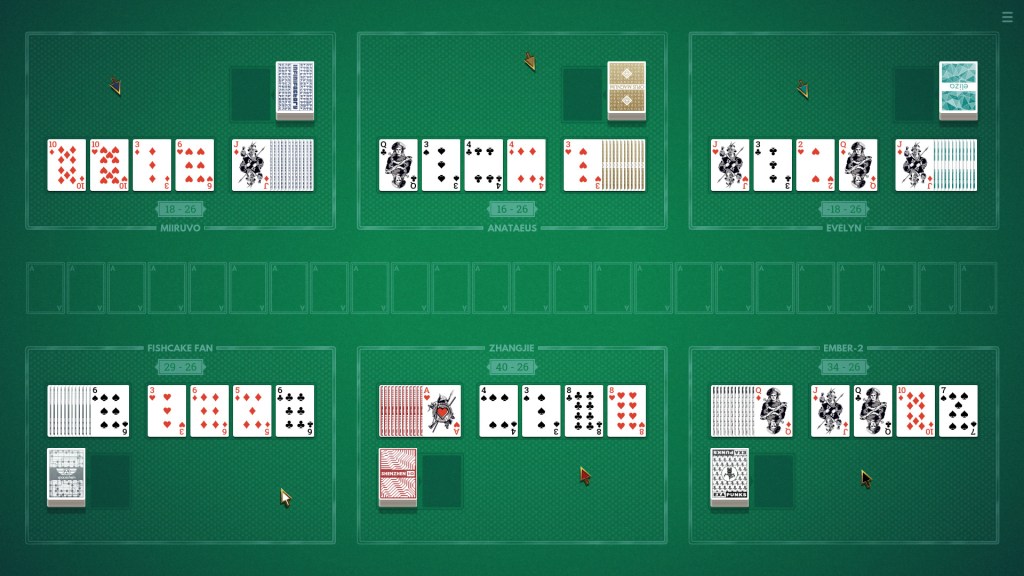
I introduced my friends to Nerts quite a while ago. We’re still playing it semi-regularly, and I’m by far the worst at it in our entire group. I’m not (that) bitter, the game is still fucking hilarious even when your score is the only one in the negatives. My only regret is learning that I have the worst card identification speed of everyone I know (Sorry, not sorry. – Kyle).
Nerts is multiplayer Klondike solitaire with a shared row of piles that you need to shed into for points. Your friends will play to them right as you were dragging the same card keeping you stuck to that very pile, leaving you with nothing. You will cry out in agony, followed by everyone laughing. It’s great, I promise. They even gave it an impeccable theme song that opens each and every deal. It is as perfect of an implementation as you could ever hope for.
So why is this an honorable mention? Because it isn’t a Zachtronics design, and it isn’t really solitaire. This is a relatively well known standard pack game that they created an implementation for after their artist introduced them to the game and the studio’s productivity likely took a nosedive. I’m extremely glad they made this freely available because Nerts rules, but I just can’t rank it among all of their other solitaires, y’know?
#9: Kabufuda Solitaire

Kabufuda Solitaire hurts my eyes. Not because it’s ugly, it’s gorgeous! I just can’t read it. And I don’t mean I have trouble reading the board, I mean my eyes unfocus when I play it because I keep trying to parse all those tiny symbols. Is this an accessibility issue? Maybe, but my eyes are technically pretty good. They just aren’t compatible with Kabufuda, and playing it on PC didn’t help.
How’s the actual game design here? Not bad. You simply need to match sets of cards, then commit them to a free cell alone. Fortunately, that removes those cards from play. Unfortunately, it also flips them over and permanently fills your free cell. Get all your cards flipped and that’s a W. The more you play the harder you can make it, eventually working down from 4 free cells to 1. I will not be making it that far.
I think I generally dislike matching solitaire (more on this later) because I rarely feel like I’m being clever as much as observant. Wins in this kind of game feel entirely decided by how much attention I’m paying. That’s not inherently an issue – solitaire is just kinda like that sometimes – but I don’t have much patience for it when it comes with a side of eye strain.
#8 Cribbage Solitaire
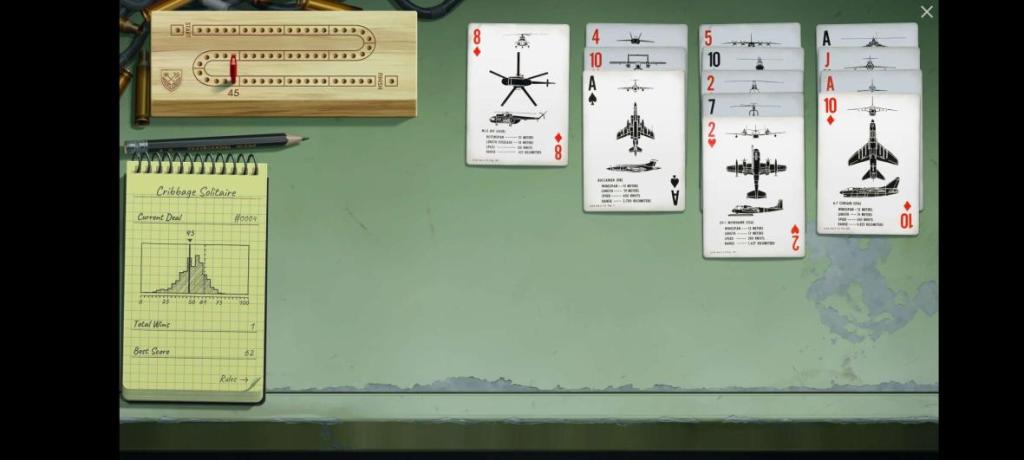
I didn’t grow up in the midwest. As a result I was introduced to Cribbage as an adult card game enthusiast. It’s a strange game, far more interested in leveraging its esoteric scoring rules to the fullest to steal points from your opponent than cardplay itself. Cribbage Solitaire retains this concept, but for solitaire, and the lack of another human feels quite noticeable.
Instead of being a traditional “clear the board” solitaire, Cribbage Solitaire lets you pick up any card you want from its columns whenever. These trigger a range of Cribbagy point scorings, like having the value of your stack hit 15 or 31 on the dot, or collecting matching sets/runs, etc. Your goal is to wring as many points from your board as possible, and since you can see all the cards from the start it comes down to just how well you’ve internalized those conditions.
The thing is, without another player to compete against I’m not particularly motivated to burn my brain on scoring puzzles. The game is soundly designed and for high score chasers I could see this being a favorite, but I’m just not that person. Let’s not talk about this anymore lest we risk a Midwest Goodbye.
#7: Sigmar’s Garden
Oh look, matching solitaire!
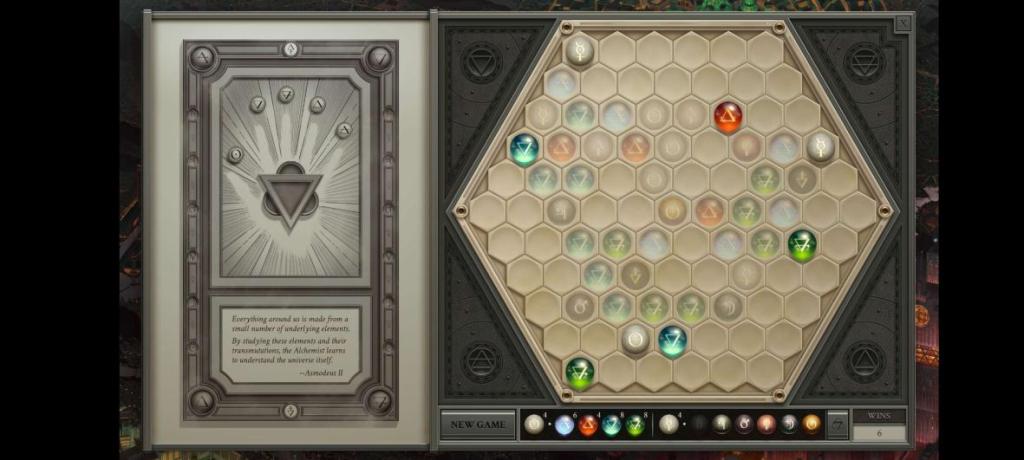
Sigmar’s Garden is the only non-card entry in this collection, and as far as I can tell it was very well received by players. I think I see why though I don’t hold it in quite as high esteem. Maybe you had to play the original game it was included with to fully “get” it? I don’t know. I am too stupid for most Zachtronics games. I just play cards, and these aren’t cards.
Gameplay-wise you have a hexagonal grid filled with alchemical candies. Your goal is to match two at a time, eating them and freeing up more candies for matching, eventually culminating in isolating the delicious golden candy at the center. It’s somewhat similar to old school mahjong solitaire but without the 3D stacking aspect. What you see on the board is all there is, and that’s both its greatest strength and weakness.
The difficulty ratings in this collection are a bit wonky (I think they may be referring to rules complexity and not challenge) but SG’s 1-star rating is absolutely correct – this game is quite easy. Moreso than any other game in this collection it’s pretty straightforward to not play yourself and get stuck. Couple this with games of SG taking maybe a minute, and much like candy you’re left with an experience that is satisfying enough while you’re playing it but leaves little long-term impression.
#6: Shenzhen Solitaire
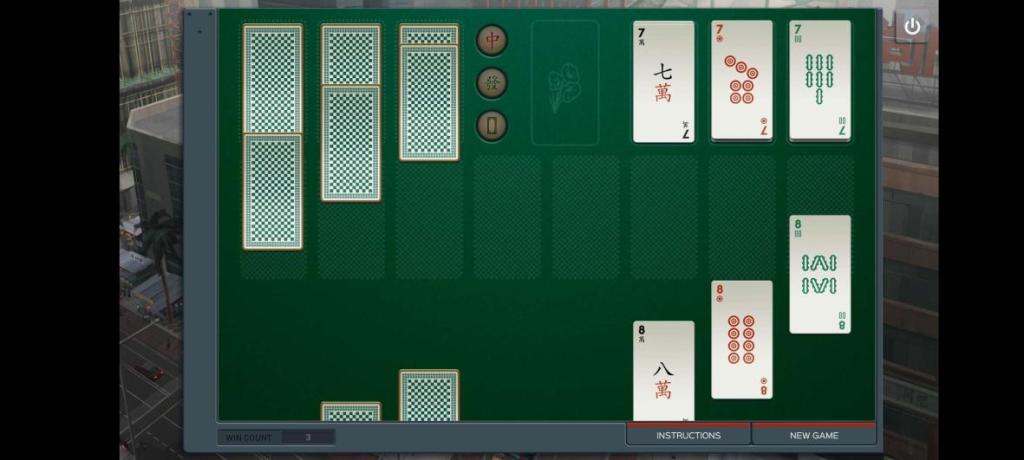
I love Mahjong. Yeah I know I talked a bit of shit about Mahjong solitaire a few entries ago, but that was Mahjong solitaire. Mahjong itself is dope, especially Riichi, and I’m a sucker for trying derivatives even when they don’t have anything to do with the “real” game. Why the aesthetic of Mahjong is so often utilized for solitaire I don’t know, but at least this game is better than the stacky-matchy alternative.
Shenzhen is pretty tough. You’ve got the standard 3 Mahjong suits along with the dragons and a single flower (no winds). Your goal is to stack with alternating colors ala Klondike, but those damn dragons will get in your way constantly. They can’t be stacked, and they can’t be moved anywhere but one of your 3 free cells. If you manage to expose all 4 you can hit a button to suck them all up into a single free cell, locking it up but removing them from the board. The goal is to go from 1-9 in all suits while mitigating the dragons to the best of your ability. Half standard solitaire, half cat wrangling.
The developer believes Shenzhen to possibly be his best design despite being his first. I obviously disagree as I’ve placed this squarely in the middle of the pack, but I do see why. There’s a purity and elegance to Shenzhen, to figuring out how not to ruin yourself as you expose more and more awful cards, to putting everything in its place bit by bit. It’s a good game, one I enjoy, but it lacks emotional resonance. It feels almost cold, overly methodical. I don’t get a sense of tension from this, nor the strong catharsis when my board is clear. Just the end result of my strategic planning, for good or ill. If that’s what makes a great game in your eyes then I absolutely see why Shenzhen could be the best, but my eyes don’t quite work that way. Lovely game though.
#5: The Lucky Seven
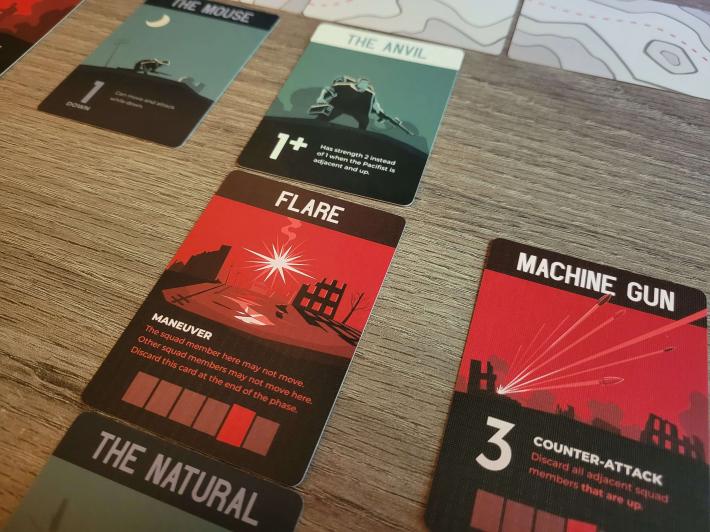
I know, I know, I wish this was #7 too. I couldn’t justify it – the game’s just a bit too good. My apologies.
The Lucky Seven is a replayable war movie in a physical tuckbox. Its 3 acts are clear to see: one of your crew gets their head turned to red mist and everyone scrambles, they take on seemingly insurmountable odds as one or more of your squad performs a heroic sacrifice, and the survivors either escape to fight another day or die legends. It’s got action, comedy, drama, tragedy, everything you want from a story. But how is it as a solitaire game?
Well it’s very different, for one. We aren’t doing suits and numbers here – this is a solo skirmish played on a grid, very much in the popular “put out the fires” coop/solo mold if you’re familiar with board games like Ghost Stories or Pandemic. Bad things are added to the table at various coordinates, you take actions with your squad, then the bad guys try to shoot your boys. The goal is simple – keep the board as manageable as possible until the threat deck runs out, then clear all the baddies in one last hurrah or die trying.
This is a remarkably satisfying riff on its genre for the scale, though it is not without some caveats. As I mentioned earlier the game starts with your 8 member crew immediately becoming the titular 7, and that first kill matters a lot. Losing the Pacifist in particular feels debilitating as two of your crew are made stronger by being near them, whereas losing a random jobber barely matters. The Mouse stood out to me as particularly strong, capable of shooting most anything with minimal risk thanks to being able to fire while “down”. Combine this with the threat deck ranging from toothless to a dentist convention depending on the shuffle, and you’ve got a game that can often feel more decided by the deal than your decisions.
But is that such a bad thing? This is the debut game from the ZT crew’s new label, and I find it uniquely striking both in its presentation and in mechanical execution to the point where I’ll be watching their upcoming work with great interest. A storytelling game of this quality in such a minimalist form factor comes along very rarely, and I appreciate this game for succeeding at what it does. Is it going to be a go-to solitaire for me? No, but I will break it out when I feel like a 10 minute war movie, and how many games can you say that about?
#4: Proletariat’s Patience
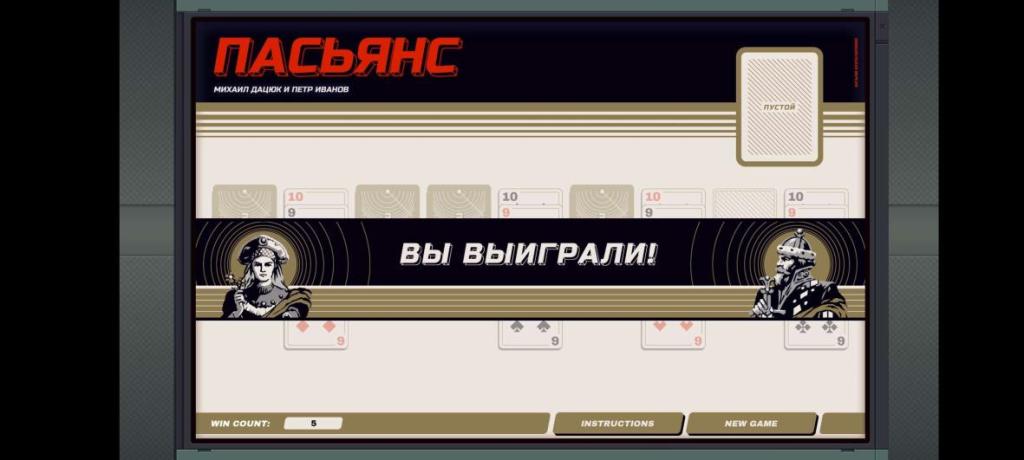
Thematic solitaire has already made an appearance in The Lucky Seven. Proletariat’s Patience is not quite so bombastic, but the story it tells is at least as interesting if not more. If TLS is an explosive war movie in card form, PP is a depressing black and white Russian film that’s 3 hours long and has an incredibly divisive collection of reviews on Letterboxd. Only, like, it’s also fun?
A game of Proletariat’s Patience is played with the smaller 36 deck that many Slavic games utilize – 4 royals per suit and the numbers 10-6. Your goal is to play out a revolution in abstracted card form, stacking all of the numbers alternating color (again, think Klondike) while grouping all of the royals by their suit alone. Each of these piles must be isolated in its own column, simulating the nobles fleeing the country as the people figuratively and literally overturn them. Also you have a free cell. This is solitaire, after all.
I find the narrative of this game bizarrely compelling for what it is. Flipping the completed sets of royals as they “flee” feels like an accomplishment, but they lock that column out, which feels almost akin to them taking their resources with them as your playable space shrinks and shrinks. Your numbers, on the other hand, stay mobile because the people’s work is never done. I can’t quite explain how Zach and co managed to design such effective theming in a relatively simple (and kind of easy) solitaire game, but it’s a magic trick I keep finding myself returning to reexamine.
#3: Fortune’s Foundation
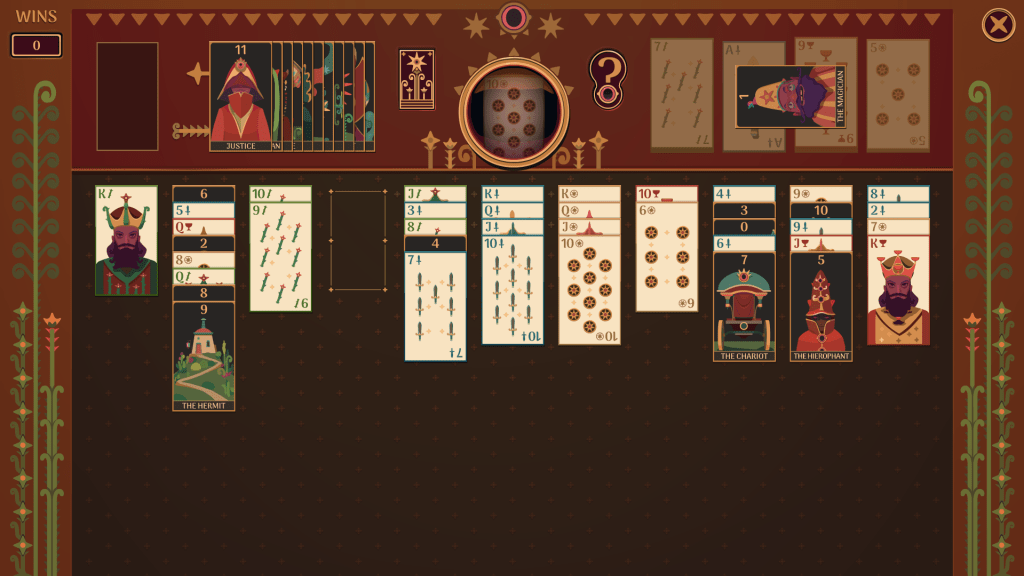
If I’m Goldilocks and Sigmar’s Garden is too easy, Fortune’s Foundation is hard as a rock. Where I differ from ol’ G-Locks is that I actually rather like rocks.
I am not intimately familiar with too many soli-tarot games. That lack of experience may be my greatest weakness here, because I find Fortune’s Foundation uniquely difficult to parse in terms of making good moves. Stacks must stay within their own suit and you can not move them as a stack, only individual cards. That may not read quite as terrifying as it actually is but trust me, taking away this common solitaire tool makes navigating the jam-packed table feel like trying to count every star in the sky without doubling up once.
That restriction is only the first of many. Need a free cell? Sure, just drop a card at the top of the board! Just keep in mind that doing so means you can no longer stack minor arcana to remove them from the board so you can get to the majors you need to actually win. You can pull that card back down, but be extremely careful to vacate that spot as soon as possible or you will get stuck. Repeatedly. This is the only game in the collection with an undo button, but one step back will not save you as often as you’d hope.
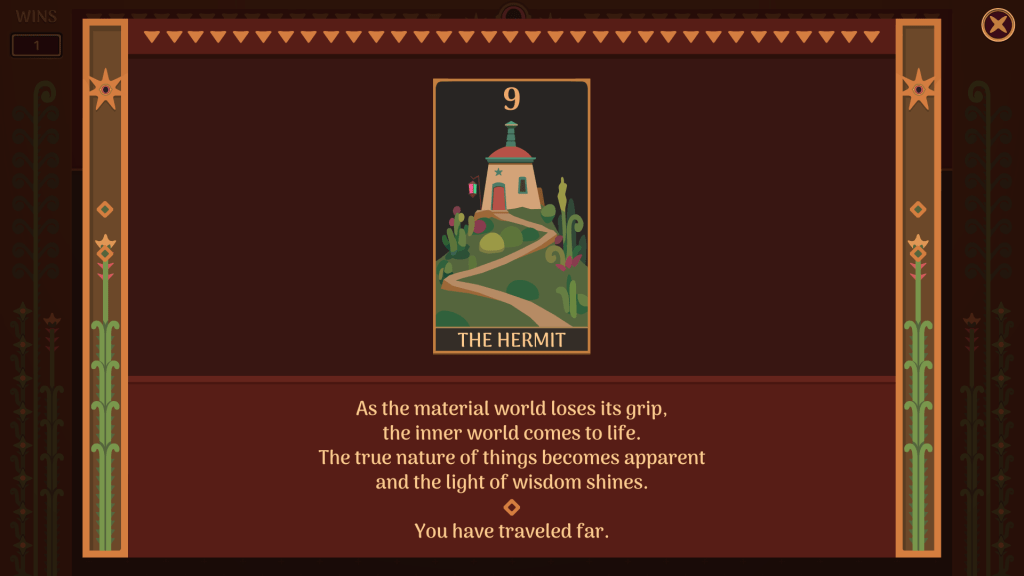
It may read like I’m not a fan of FF. That couldn’t be further from the truth; in fact I kind of love it. I struggled with this for days and when I finally got my first win it felt like a genuine achievement. I refused to look up any info on any of these games until I’d beaten them all at least once, and in FF’s case I discovered a small, passionate group of players who had cleared it over 100 times, many of which were in a row. Learning that most/all deals were winnable blew my mind. There are perilous depths here, and I have found myself tempted to see what lurks below.
FF is not a relaxing-with-my-morning-coffee-friendly game. Not yet for me, anyway. It can also be quite frustrating, both by design and by each deal. But it’s the friction that makes it so attractive, the tempting reward of a reading that might make you think a bit differently about your day. This is a stellar solitaire game.
#2: Sawayama Solitaire
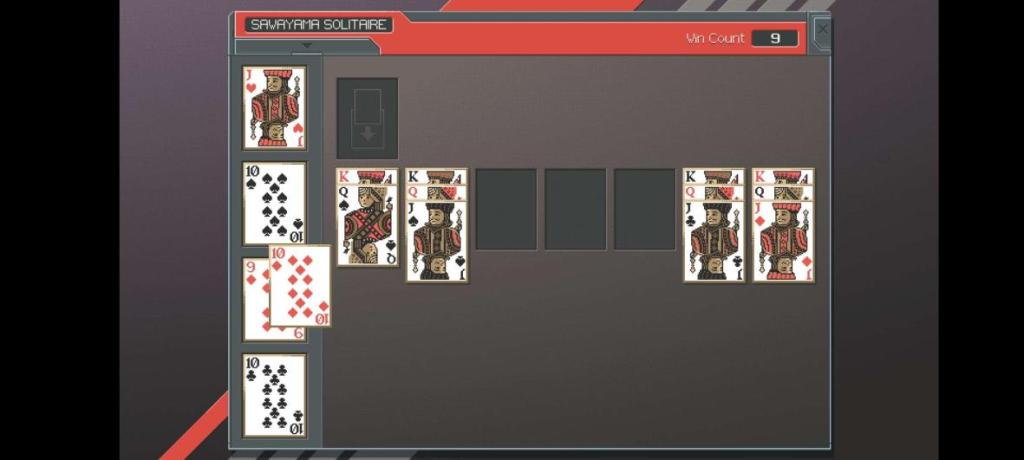
Chasing Fortune’s Foundation with Sawayama Solitaire in a ranked list looks crazy. After all those words about a game that fundamentally challenged my perception of solitaire, am I really going to rank a Klondike variant higher? Return to the world of redeals and rough card flips?
Hell yeah I am. Sawayama is an in-universe riff on classic Windows Klondike as per the description, and it improves on its inspiration in every possible way. Great visual presentation, some fun mechanical changes that force you to approach it differently, and my favorite music track in a collection with several winners. Playing Sawayama feels like you’re a high power executive of the retro-future that’s been promoted to the point of not having to work anymore, and now your greatest challenge is getting a win or two in before heading out for your 2:30 low-grav golf game.
Make no mistake, there is a lot of Klondike DNA here but it also differs greatly. The main differences are that you can start a column with any card, you flip 3 cards off the deck at a time, you only go through the deck once, and you gain a free cell once the deck is gone. All of these have wild ramifications on the game. You have a lot more freedom, but can also get yourself stuck way more easily. 3 cards gives you info, but it also means you have to dig to get some of the cards you may need. Burrowing through the deck quickly gives you flexibility, but at great cost if you can’t make the most of your one trip through.
I am completely, painfully addicted to Sawayama Solitaire. This has fully replaced any normal kind of solitaire for me. I play it on my phone, I got the collection on Itch so I could play it on my PC without constantly alerting my Steam friends, and I am lured to run another game of it at all times. The hooks are in me and they are in deep. Every change it makes on Klondike makes it smarter, sharper, exciting, moreish. It feels like a modern classic, or maybe an honest to god sequel for the last game you’d ever expect to get one. Sawayama Solitaire rocks. You should play it. It is the game in this collection I have played and will play the most. But it is not my favorite.
#1: Cluj Solitaire
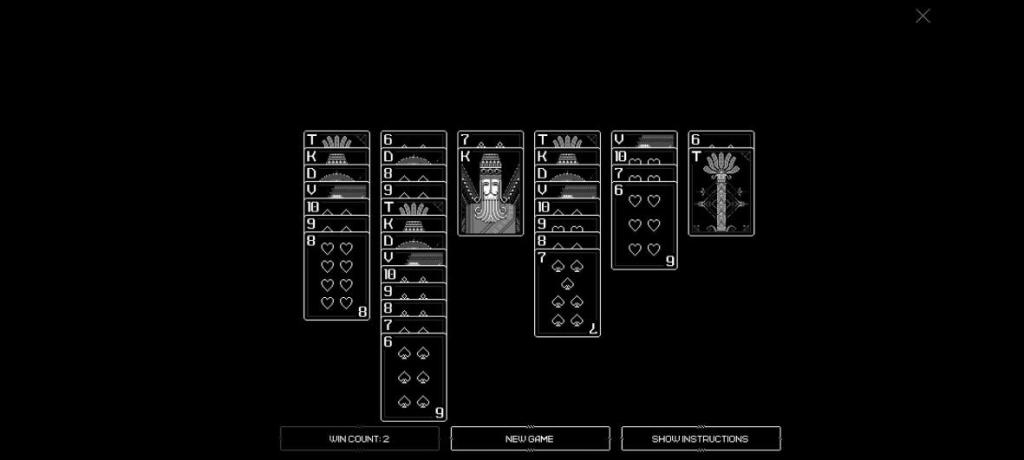
Subverting expectations has become predictable. You can’t just take a convention and flip it for the sake of it; there needs to be a reason or it’ll ring hollow. Cluj Solitaire demonstrates a particularly effective form of subversion by taking a genre that’s typically smooth, comfortable, cozy even, and turning into a horror game.
Cluj is by far the most visually striking game in the collection by way of sheer minimalism. Once again we have the Russian deck, only this time it’s divvied into 6 columns and actually uses the original 4-royal set: Tuz, Korol, Dama, Valet – TKDV. Remember TKDV. Repeat it. Tattoo it like Memento, burn it into your brain, because you’re going to be muttering it under your breath like a madness mantra as you play.
Your goal, stop me if you’ve heard this one before, is to put columns in order from T to 6. The cards have no suits (hence being entirely in black and white), but you don’t have anywhere near enough room to rearrange cards legally. The system is against you, you cannot win. At least, not without a little creative interpretation of the rules.
I’ll stop burying the lede: Cluj lets you cheat. You can drop any single card on top of any other column, at which point its color inverts. That card is now stuck and locks every card under it until you find a way to play it legally. This initially feels like an insane amount of freedom, but you’ll quickly find that you’re running with a shock collar if you get a little too stack-happy. The game does not want you to win, and it’ll happily let you ruin yourself at any moment.
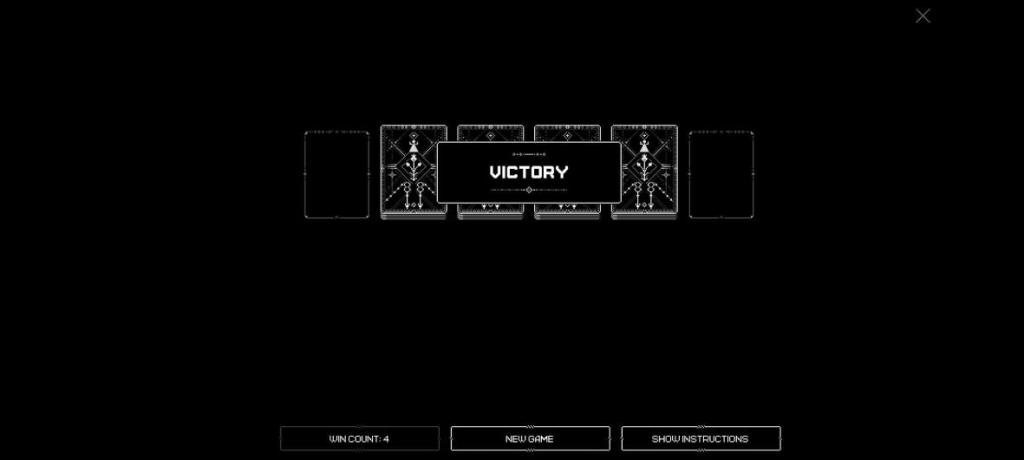
Couple all of this with the constant unsettling background noise – not music, noise – and the stylized visual “glitching” on each card you cheat with, and you have a game that’s far more arresting than any other traditional-ish solitaire game I’ve ever seen. Even when you win you’re met with an abrupt pop up that simply says “victory”, as if the game was programmed under the assumption that you’d never get that far so why bother with fanfare. It’s an unnerving experience, very much unlike anything I’ve seen in any card game much less solitaire, and it’s fantastic.
Cluj is a devious, hateful little game that will hang you by your hubris faster, and with more glee, than any game in this collection. It does not like you. It may not even like itself. It is not the hardest game in the mix, nor the deepest, and it isn’t even the one I’m most compelled to replay the most. But it will always be the first one I recommend, the one I’ll never forget, and the one I feel demonstrates Zach and co’s mastery of solitaire the best. Cluj fucked me up and I love how much it hates me.
 Reviews as Fair as a Die Roll