

Steel Moosheep Wool
Fuga: Melodies of Steel can only be explained as a passion project. For a game that didn’t make a profit to not only get a sequel but have it release in the same window as Tears of the Kingdom, and then mention that it’s intended to be a trilogy? That’s an almost unhinged amount of commitment to a project. I had to find out what it was about this series that’s inspired such dedication, so I started at the beginning.

Fuga’s writing is a bit of a unique case. The overall narrative beyond its overall premise of “what if children piloted a Helltank in not-WW2” doesn’t go too much further than that summary, and in terms of plot-relevant dialogue the kids won’t blow your mind either, but that’s the thing – they’re kids. They’re written like kids, with limited understanding of their circumstances and coping with their struggles by focusing on their personal interests. While the game is definitely more focused on presenting interesting combat I didn’t find the characters to be lacking in the least, particularly in the heaps of optional side chatter as you build their bonds. It’s likely the cutest game about the horrors of war and fighting against generational hatred you’ll see.
That said this game is really about its combat system above all else, and it’s a good one. What we have is a turn-based JRPG type of thing, except your health and SP bars are shared as they belong to the tank. Stats and skills, on the other hand, are unique to each kid. Boron is a cannon user who hits like a train, Mei is a speedy machinegunner with some support capabilities, Socks is a grenadier with a specialty in status effects, etc. Those weapon types matter because each enemy type has a unique set of weaknesses that, when hit with, will delay their turn. Combat has a fairly steady cadence to it: start a fight, arrange your team to best capitalize on their weaknesses, win as efficiently as possible for an XP bonus, repeat.
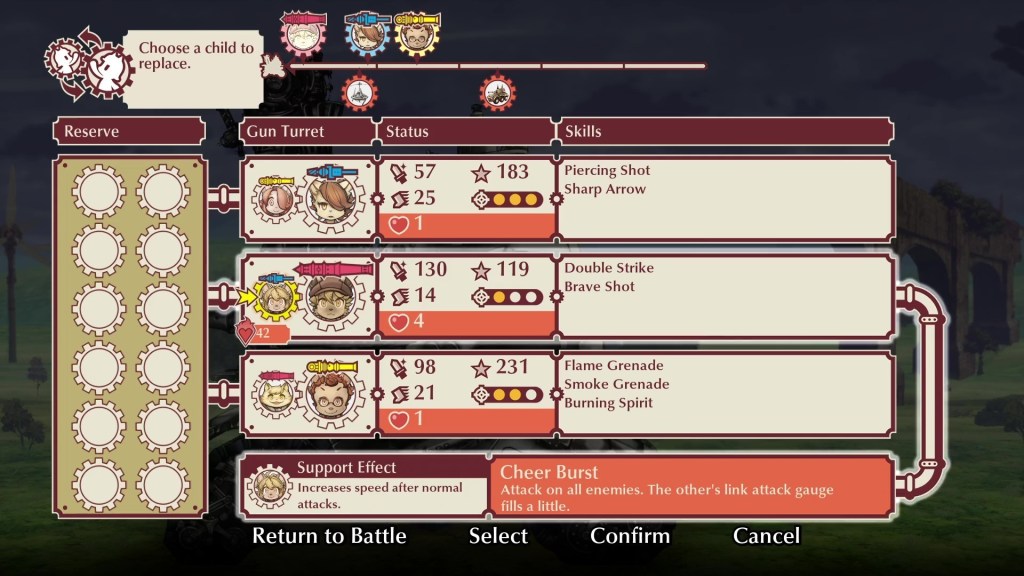
Surprisingly for a game with so many party members there is actually a chance that you’ll use them all. Fuga offers a dozen characters for you to coordinate and not a single one of them is a dud. Thanks to the link system, which sees you pairing characters on each gun with one shooting and the other providing unique passive benefits, you’re essentially building custom classes on the fly. Moreover, you’re incentivized to have those kids hang out between fights more often as higher level bonds mean even stronger passives. But on another more sinister hand, there is another reason for the quantity of party members: the soul cannon. If you find yourself struggling in a fight the tank’s soul cannon will come online. Want to blow your opponents to kingdom come? No worries, all it’ll cost you is one (qty 1) child! That’s not a KO to be clear – that’s a kid removed from your party forever.
This, combined with being able to completely restructure your party every 3 turns (these kids get in a lot of cardio) makes for a battle system that rewards creativity while not necessarily demanding it. Even if you’re intent on not using the cannon for story purposes, the addition of the sinister glowing button to your command list when your health drops low enough serves as a force multiplier for the tension of the tougher fights. It’s there to remind you that you could just win with it, and also you have so many party members, surely you aren’t using all of them? Or at least that’s what it should do in theory. In practice…
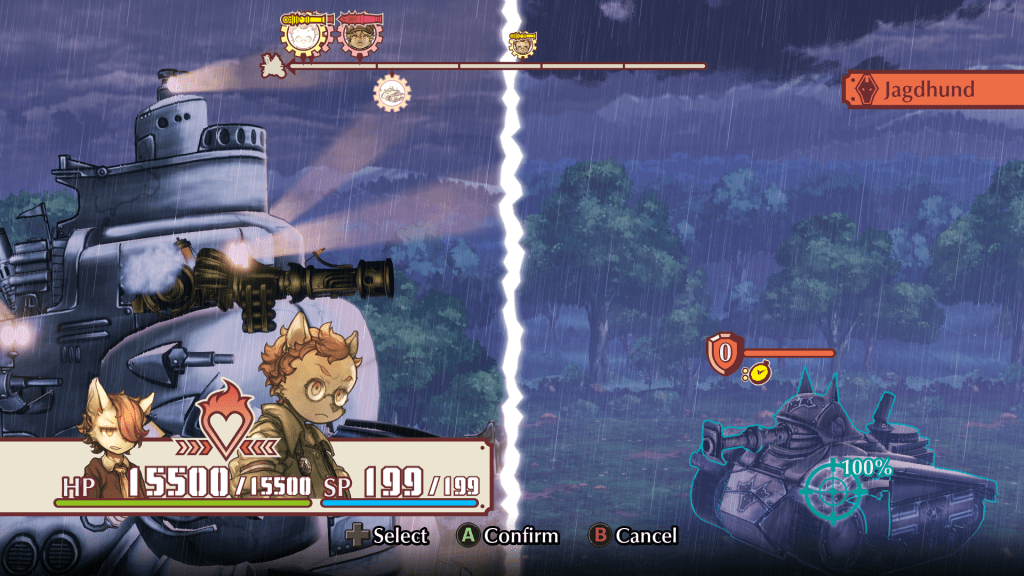
Look I have some issues with Fuga, but I want to preface this by saying they may be issues of my own making. In my playthrough I took the hardest route at every opportunity. This meant I was stretched thin early on but ensured I got more XP and materials than I otherwise would have, which seemed to create a compounding effect that ended in the latter half of the game being notably easier and the final act in particular being a cakewalk. I cruised through it up to and including bumbling into the true ending. This isn’t intended as a brag – I think I had a worse time because of it!
Fuga wants to be a game about sacrifice both narratively and mechanically. If you play it like I did and optimize encounters, this falls apart on both fronts. Being able to swap your party around every 3 turns just felt way too strong, especially as you can change turn order to ensure your heavy hitters act faster. Between constant restructuring of my crew and an arguable overabundance of resources I almost never saw the soul cannon prompt even come up after the halfway point because I just wasn’t in any danger. As a result the narrative never got to develop or dwell on struggles or loss because I never had any. My kids ate well, fought well, saw their desires met, and rode off into the sunset. Difficult, consequential decisions in a narrative only work when you don’t leave it up to the player to please make the “bad” choice just to get a taste of pathos, and Fuga doesn’t put up enough resistance to warrant foomping the kids when you can simply win every combat as-is. To summarize: if you play to win the game is worse.
There are a handful of technical issues worthy of mention and I don’t have a natural segue for them. Visual glitches are frequent though minor, particularly in the intermissions as you move in and out of menus. Some intermission actions locked up for a while after selecting options, only to return to the initial selection textbox before eventually processing the original selection. The worst by a long shot was the barter softlock. Sometimes when you attempt to barter between battle sections you just get stuck with looping audio and your purchase never completes. This forces a reset, and was so irritating that I eventually completely stopped bartering. Beyond occasionally slowing down an upgrade this presented little issue which is probably not a good sign for its implementation in the first place.
Fuga is a game that grew on me until about the halfway point, then slowly lost me as it ran out of ways to present an interesting challenge. The game loop gives way to monotony as you hit the same enemies for the same weaknesses, use the same half dozen maxed out character pairings, do the same tasks in the intermissions, and smoke the boss at the end of each chapter before starting it all again. I said I love this combat system and I meant it, but it needed to be pushed further, stretched more, and oppose the player with enemies that tested your multitasking capabilities and adaptability. As it stands the game offers a good foundation and little else, which makes the 15-ish hour runtime for the first playthrough feel excessive. I played this with the intent of following it up with the recently-released sequel, and I still intend to do so because I find its premise and mechanics compelling, but I hope to see Cyberconnect2 deliver on these ideas with a bit more finesse when I do.
6/10
Reviewed on Xbox Game Pass.
 Reviews as Fair as a Die Roll