

Hey friendo, you’re back. Let’s talk plot, themes, and feelings. This isn’t as organized as the review, just thoughts that stood out from my plays.
Adios is about a lot of very heavy emotions. Guilt is the obvious one but to say this is a game “about” guilt is reductive. No one feels guilt in a vacuum, there’s always more feeding into it. Decisions that were made, circumstances that influenced those decisions, being emotionally compromised, you name it. In this case the farmer is suffering and has been for a long time. As he sees it, the mob is content to simply use him and his pigs forever for their own purposes. He’s already lost his wife, his son, and any friendships he had outside of the deal with the mob. The only “friend” he has is using him. He is alone, and has been alone for a long time. A man left alone with thoughts like his is bound to come to a lot of conclusions, good or otherwise.
It isn’t that simple though. At one point his friend offers him a chance to leave, go somewhere else, meet someone new. The farmer dismisses this out of hand. His refusal to entertain that thought isn’t born of stubbornness, it’s knowing that simply relocating cannot fill the void in his soul. A soul that, at least to him, seems dangerously close to the eternal abyss. And this begs the question – is he right? Does all this time making bad decisions matter, and if it does, can he fix it with one good act? And is that act even good, or is it a deeply pained man’s attempt to construe a situation in which he is more than his past actions?
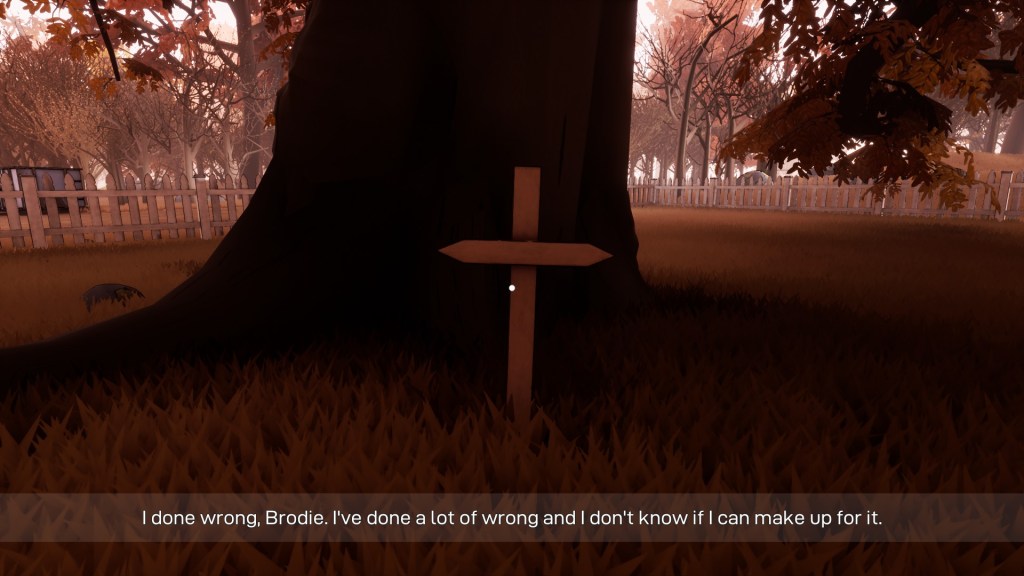
I’ll give you my read because it’s the only one I’ve got: I the farmer is doomed. No man can spend decades contributing to great harm this way, profiting from spilt blood, and redeem himself without doing right by anyone affected. From playing the game I see that he genuinely believes he’s making things right somehow, if only in some kind of karmic sense, but I believe that he is wrong. And not just wrong, wrong in the most selfish way possible. He may want nothing more than some kind of forgiveness and redemption but his solution to the problem simply is not applicable.
I mentioned at the end of the review proper that Adios made me cry. It was the phone call with the farmer’s son Bill that did it. Part of this was due to it resonating on a personal level as I’ve lost a lot of family in similar ways, but I don’t want that to diminish how effective I think this scene is at laying the core of the farmer’s character bare. Bill is a victim of the farmer’s commitment to the mob’s deal despite it being taken to save his life to begin with. He had to track his suffering mother down in a nursing home that the farmer put her in despite his wishes. She was lucid, he says, though knowing Alzheimer’s that was almost certainly momentary. The farmer thinks as much but can’t bear to tell his son (represented by a grayed out dialog option), remembering moments where she reacted to him with fear because she didn’t recognize him.
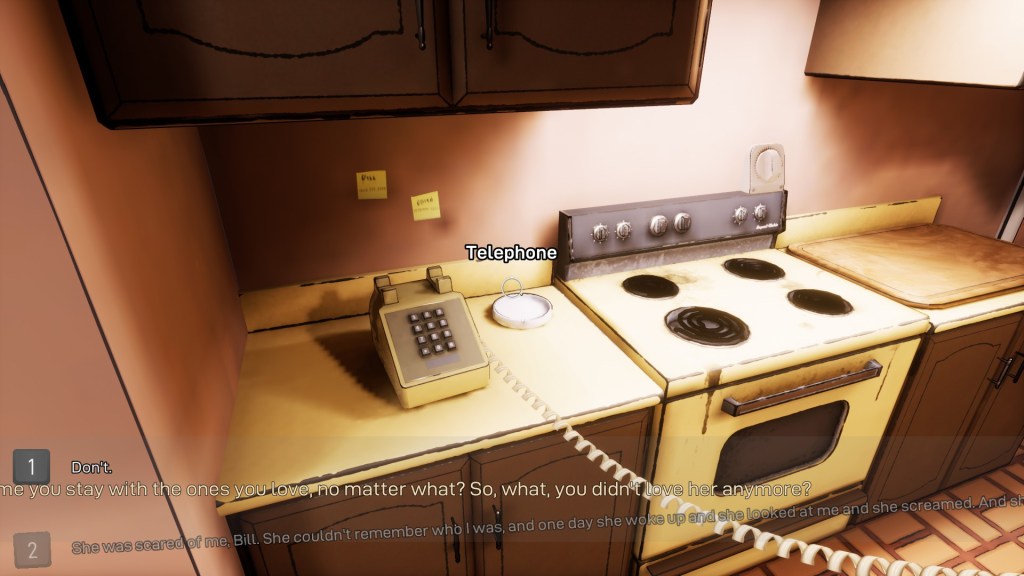
But that doesn’t matter from Bill’s perspective because he doesn’t know, and he doesn’t know because the farmer just can not figure out how to communicate it. As far as Bill’s concerned she was callously dumped off by the man she loved just so he could keep his farm life intact. Bill doesn’t know what his dad did to save his life during childhood or what he continues to do but I don’t think having the full context would make him much happier.
What this made clear to me is just how alone the farmer is, and how almost all of that is as a result of his own actions. As he mentions in the Root Bear scene (not a typo) he doesn’t grieve in a way most would consider normal. He’s driven to fix things, and the process of repair fixes him in turn. But time and time again life presented things he simply couldn’t fix, or worse, things that his choices rendered un-fixable. He has regrets and the desire to do right, but whether it’s due to grief’s unending toll or simple cowardice he sees no way out.
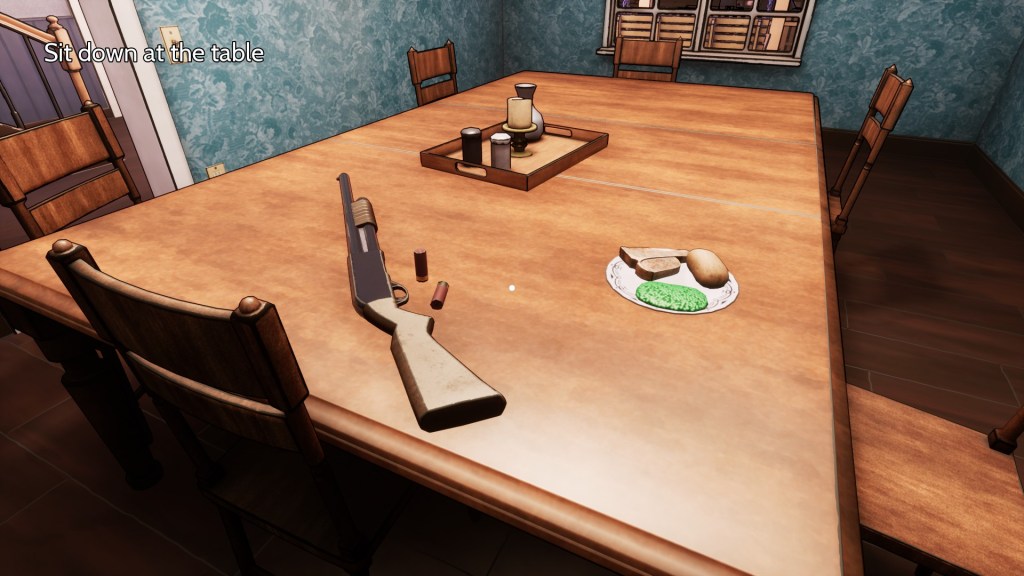
And maybe he’s right. Sometimes there isn’t an out. But suicide-by-mob does nothing but remove him from the equation, and no amount of forgiveness undoes a bullet to the head. I don’t know if there’s a hell in the world of Adios but I do know that the farmer’s last stubborn choice only ends one person’s pain. If he’s right that there’s a place where bad people go and a place where good people and dogs go, his choice wouldn’t save him from the former. The farmer signed a deal with the devil in the summer of ’78 and doomed himself along with everyone he cared about. It was only a matter of time before the devil came to collect on what was rightfully his.
On a final, lighter note: I do not trust that horse.
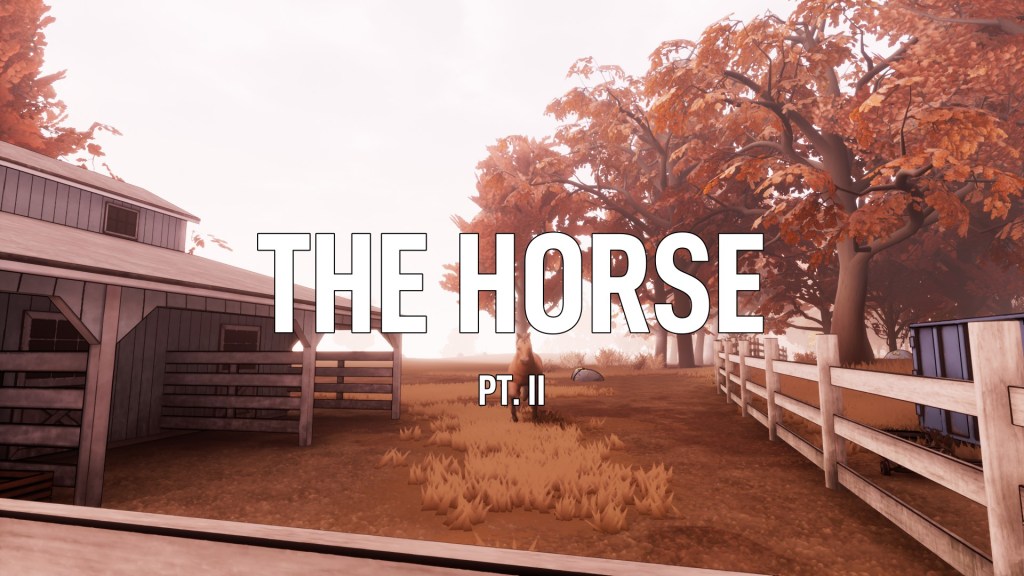
Don’t like it. Something’s off. Gets my arm hair up. I think it’s the eyes.
Pages: 12
 Reviews as Fair as a Die Roll